James Webb telescope finds one of our galaxy's rarest stars inside the 'Treasure Chest' globule — Space photo of the week
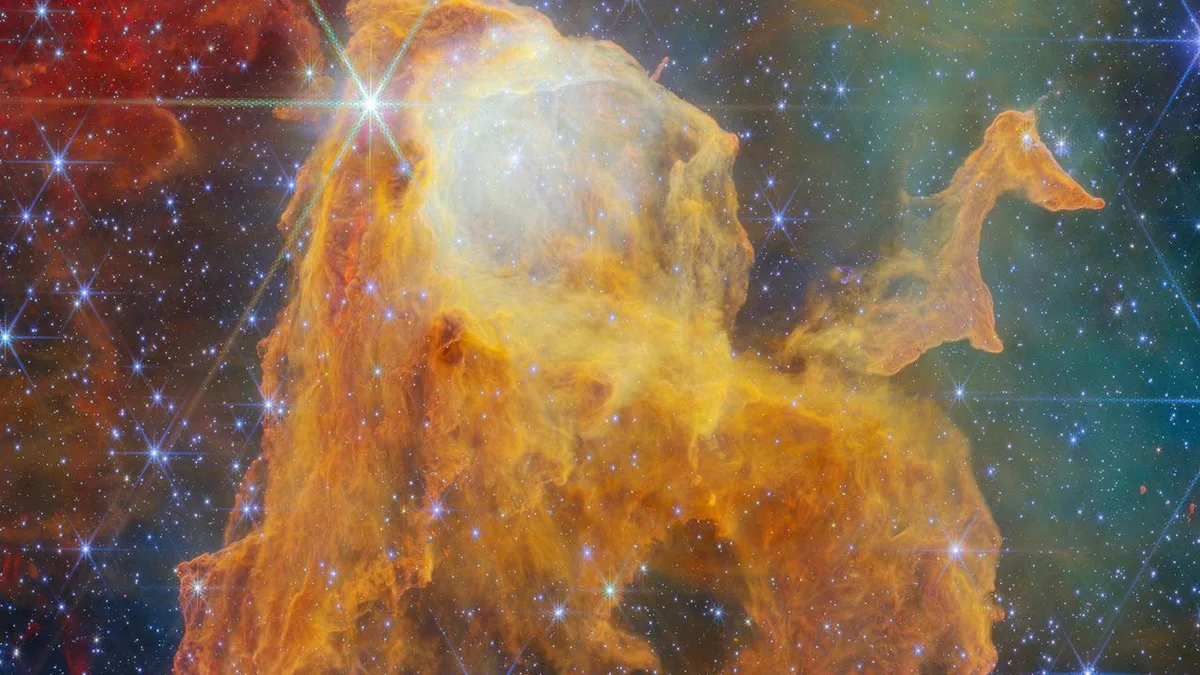
NASA's James Webb Space Telescope captured the "Treasure Chest," a cometary globule in the star-forming Carina Nebula, on Aug.
6, 2026 (Image credit: ESA/Webb, NASA & CSA, M.
Reiter; Acknowledgment: M.
H. Özsaraç) Quick facts What it is: The Treasure Chest, a cometary globule in the Carina Nebula star-forming region Where it is: 7,500 light-years away, in the constellation Carina (the Keel) When it was shared: Aug.
21, 2026 It looks like a gigantic treasure chest left open among the stars — but instead of gold and jewels, this strange cosmic structure contains dozens of newborn suns.
This new image from the James Webb Space Telescope (JWST) reveals the aptly named Treasure Chest, a colorful cloud of gas and dust in the Carina Nebula, one of the Milky Way's richest star-forming regions.
Located about 7,500 light-years away in the Southern Hemisphere constellation Carina, the nebula stretches roughly 260 light-years across and contains some of the most massive stars in our galaxy, as well as tens of thousands of young protostars.
It's also home to the "Cosmic Cliffs," which appeared in JWST's first collection of science images , released in 2022.
The Treasure Chest is a cometary globule, an isolated cloud with a dense, dark head and a sweeping tail.
Although such objects are named for their resemblance to comets, this one looks more like a wooden chest with its lid propped open and light spilling from inside.
JWST's Near-Infrared Camera reveals the source of that glow: a compact cluster of about 70 young stars embedded in the dust.
The most massive one is a rare O-type star — extremely large, bright, and short-lived stars — measuring roughly 19 times as massive as the sun.
Astronomers estimate that the cluster is around 1.3 million years old, although earlier estimates suggested it could be as young as 100,000 years.
Many of its stars are still surrounded by the gas and dust from which they were born.
5News aggregated this summary from the outlet’s public feed. The full article, with all the context, is on www.livescience.com — the content belongs to Live Science.