Blue Origin adding second pad to Cape Canaveral launch complex amid rocket explosion repairs
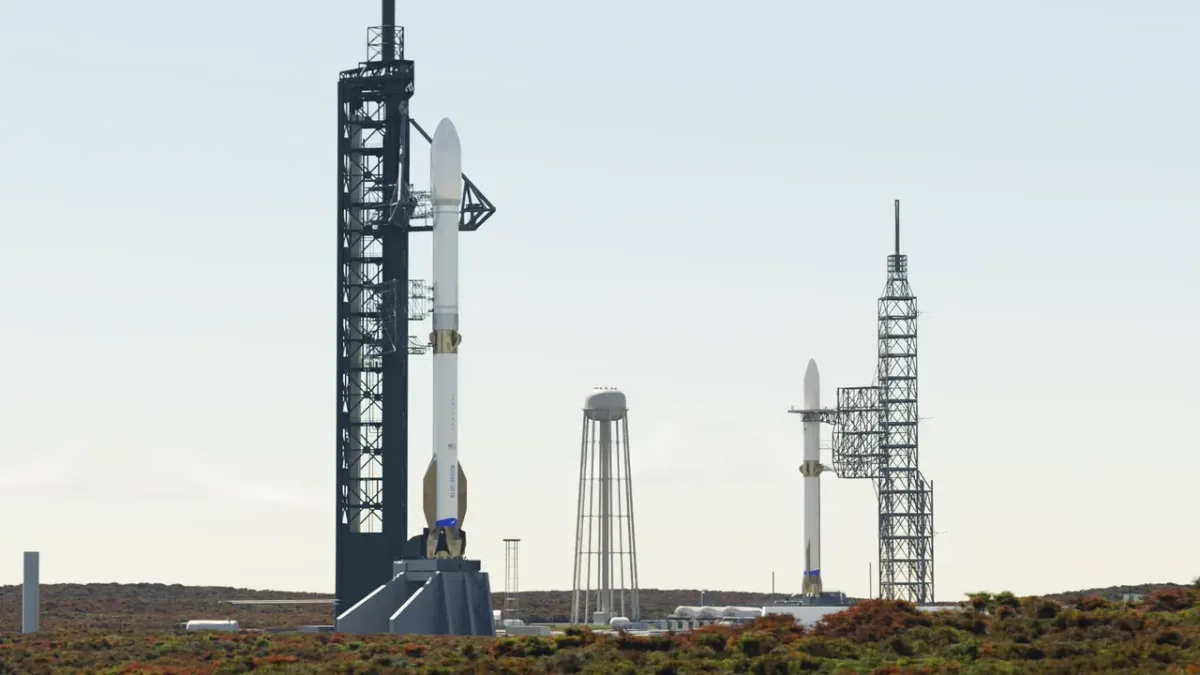
Blue Origin plans to return its Florida launch site to a dual-pad facility to support its bigger, more powerful New Glenn "9x4" rocket, which is still under development.
As facility repairs continue following the explosion of one of Blue Origin's New Glenn "7x2" rockets during tests at Cape Canaveral Space Force Station's Launch Complex-36 in May, the company has announced its intent to expand the site with an additional pad.
The company also plans to build operations infrastructure for the complex on land nearby, which will include a Vertical Integration Facility (VIF) for the New Glenn 9x4 vehicle, and a Payload Processing Facility (PPF).
Blue Origin has expressed confidence in its ability to complete repairs at its existing LC-36 pad (LC-36A) in time for New Glenn 7x2 to return to launch by the end of the year, but the company did not state a timeline for the readiness of LC-36B or an expected debut of New Glenn 9x4.
The 7x2 and 9x4 designations are a denotation of the rockets' engine configurations.
It's similar to SpaceX's name for the Falcon 9 rocket, which is powered by nine Merlin 1D engines on its first stage, arranged in a circle of eight around a single engine in the center.
New Glenn's first stage is powered by Blue Origin's BE-4 engines, and the rocket's second stage uses BE-3Us.
Both New Glenn first-stage configurations are designed for landing and reusability.
The 7x2 flies with seven BE-4 engines on its first stage and two BE-3Us on its second stage.
Subsequently, the taller, yet-to-debut New Glenn 9x4 will be powered by nine BE-4 engines on its first stage and four BE-3Us on its second stage.
It will therefore be capable of launching larger, heavier payloads into space.
For roughly four decades beginning in the 1960s, LC-36 was home to two pads that supported the Atlas-Centaur family and, later, the Atlas I, II and III rockets.
In that time, the pads hosted launches of NASA's Surveyor , Mariner and Pioneer probes, as well as commercial and national-security payloads.
But that era ended in the mid-aughts as those Atlas rockets reached retirement.
5News aggregated this summary from the outlet’s public feed. The full article, with all the context, is on www.space.com — the content belongs to Space.com.