Rare sunlight trick transforms Pacific island into a giant silver 'magnifying glass' — Earth from space
QUICK FACTS Where is it? Rennell Island, Solomon Islands [ -11.589514301, 160.17549068 ] What's in the photo? A "sunglint" shining off the ocean and the island's lake Who took the photo? An unnamed astronaut on board the International Space Station When was it taken? Jan.
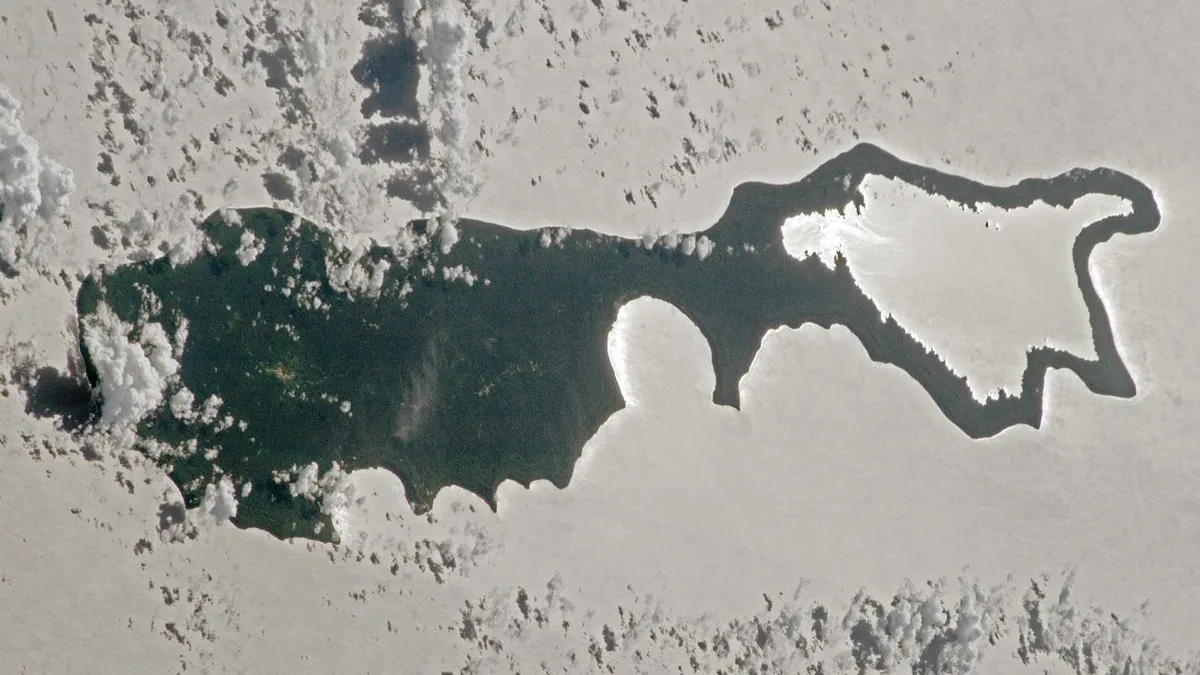
8, 2023 This eye-catching astronaut snap shows a rare phenomenon known as a " sunglint ," which transformed a Pacific island into a pseudo-magnifying glass with a shining silver lens.
The uniquely shaped landmass is Rennell Island (also known as Mugaba or Mu Nggava), one of the southernmost of the Solomon Islands — an archipelago nation of nearly 1,000 islands, atolls and reefs that lies between Australia, Papua New Guinea and Fiji.
It is up to 50 miles (80 kilometers) long and 8 miles (13 km) across at its widest point.
At the southeastern end of the island (right side of this photo) lies Lake Tegano (also known as Lake Te Nggano), a roughly 60-square-mile (155 square kilometers) body of brackish water, which is surrounded by a jagged ring of coral topped with dense forest.
It is the largest lake on any Pacific island, according to Britannica .
In this photo, sunlight reflects off the surface of both the Pacific Ocean and Lake Tegano directly into the astronaut's camera, making the water appear metallic.
This sunglint effect is the strongest on the lake's left side and a horseshoe-shaped bay on the island's bottom edge, because these areas are most sheltered from the wind and therefore have the stillest and most reflective surfaces, according to NASA's Earth Observatory .
Shadows from clouds are peppered across the sea's silver surface, adding an element of depth to the scene.
Lake Tegano is the largest lake on any of the more than 20,000 islands in the Pacific Ocean. (Image credit: Wikimedia) Sunglints are useful to scientists because they can help reveal hidden oceanographic features , such as subsurface currents, oil slicks and internal waves, which look like marks on a mirror when this phenomenon is ongoing.
Sunglints can also occur on land when sunlight reflects off rivers or illuminates large lakes .
However, the reflected sunlight can obscure parts of aerial images, making them a nuisance in certain tasks, such as hurricane tracking .
As a result, sunglints are digitally removed from most satellite images, according to the National Oceanic and Atmospheric Administration (NOAA).
Rennell Island is an atoll, meaning it is built on top of the remains of an ancient coral reef, most likely left behind when another island sank into the sea long ago.
5News aggregated this summary from the outlet’s public feed. The full article, with all the context, is on www.livescience.com — the content belongs to Live Science.