The Supreme Court just handed Republicans a surprisingly decisive midterm loss
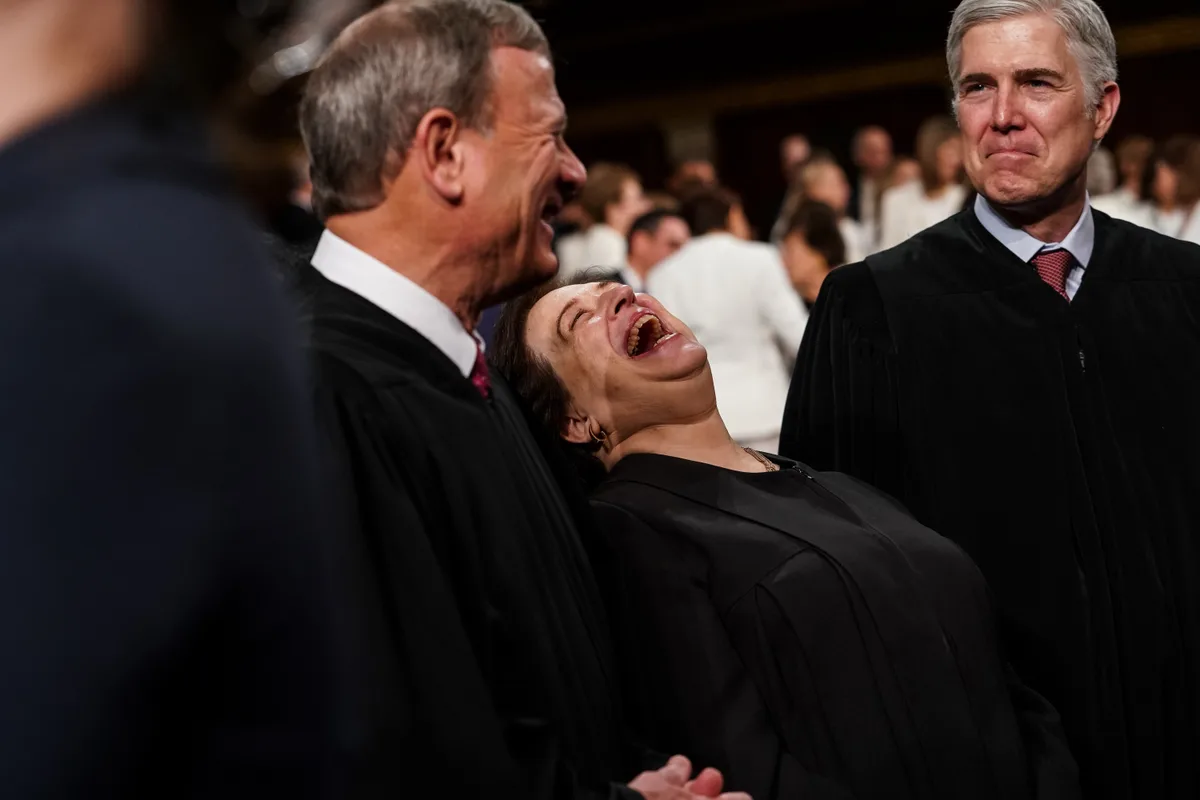
Justice Elena Kagan, laughing | Doug Mills/Getty Images Wow, that was quick.
At 10:03 am ET , according to the Supreme Court’s docket, a group of Republican plaintiffs filed a brief asking the Court to bless a GOP gerrymander in Missouri.
Less than half an hour later, the Court issued a brief order telling these Republicans no — a rare scolding from this Court for the Republican Party, and a rejection of the party’s latest effort to skew elections in its favor.
The decision is notable for this Court, but it isn’t particularly surprising.
Earlier this week, Justice Brett Kavanaugh denied a similar request from another set of Republican litigants.
But, minutes after Kavanaugh did so, a Donald Trump-appointed federal judge issued a new order that would have forced Missouri to use the Republican Party’s maps anyway.
The Court’s new decision in People Not Politicians v.
Onder places that judge’s decision on hold.
As a practical matter, this means that, in the upcoming midterm elections, Missouri will almost certainly use the same maps it used in the 2024 election — which elected six Republicans and two Democrats to the US House — rather than the new maps, which were designed to give Republicans an extra seat.
Reading between the lines of the Court’s order in People Not Politicians , it appears that the justices were quite frustrated by the Republican Party’s tactics in this dispute.
When Kavanaugh previously denied the GOP’s request to use its new gerrymandered maps, he did so using a process that allows a single justice to dispose of a case — a process the justices rarely use unless they view a matter as so one-sided that it’s not worth formally involving their colleagues.
Similarly, the Court’s new order was issued almost immediately after the Republican plaintiffs filed their brief — so fast, in fact, that it’s unclear whether the justices even had time to read that brief.
And the order also appears to be unanimous .
No justice indicated that they dissent (although it is possible that one or more justices disagree with the order but decided not to make that disagreement public).
5News aggregated this summary from the outlet’s public feed. The full article, with all the context, is on www.vox.com — the content belongs to Vox.