Earth is in the firing line of a strange new type of cosmic object, astronomers say
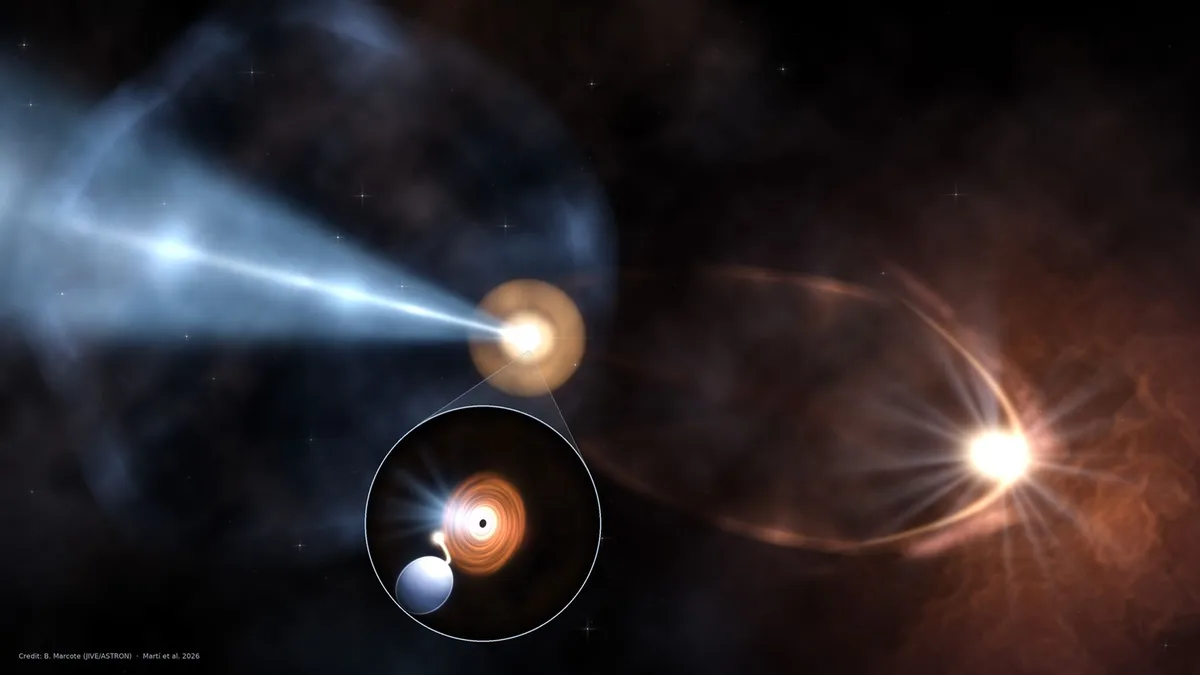
Researchers have observed the strongest candidate yet for a "microblazar" — a dazzling object that has long been predicted to exist but never spotted.
Observations of microblazars would give astronomers closer views of black holes emitting powerful jets of energy and help them understand how these extreme objects behave.
Blazars are some of the most energetic objects in the universe .
They are a type of quasar — a brightly glowing object fueled by a supermassive black hole stripping material from its host galaxy and then ejecting some of it in powerful, opposing jets of particles and radiation.
To qualify as a blazar, one of those near-light-speed jets needs to point directly at Earth.
Astronomers have previously discovered smaller versions of quasars, dubbed microquasars , and long theorized that there must be smaller versions of blazars as well.
Now, an international team led by astronomers in Spain, the Netherlands and Argentina has described a microblazar in a study accepted for publication in the journal Astronomy and Astrophysics .
"It is the first time that we have a serious candidate," Josep Martí , an astronomer at the University of Jaén in Spain and first author of the study, told Live Science.
The object, called IRAS 18293-0941, is located in our galaxy, about 12,000 light-years from Earth, and it's hidden behind a veil of dust.
It is a binary system that includes a black hole that orbits a hot, gigantic star every 11 days.
Matter from the star falls into the black hole, and some of this material is jettisoned into the surrounding environment in two opposing jets.
One of those jets flares toward Earth.
Comparison between the astronomical images of IRAS 18293-0941 (left) and the artist's impression (right). (Image credit: B.
Marcote (JIVE/ASTRON).) These objects, as well as microquasars in general, are tricky to observe, Martí said.
5News aggregated this summary from the outlet’s public feed. The full article, with all the context, is on www.livescience.com — the content belongs to Live Science.