1,000-mile-long cloud that forms and vanishes on Mars every day obeys 'exotic physics' never seen on Earth
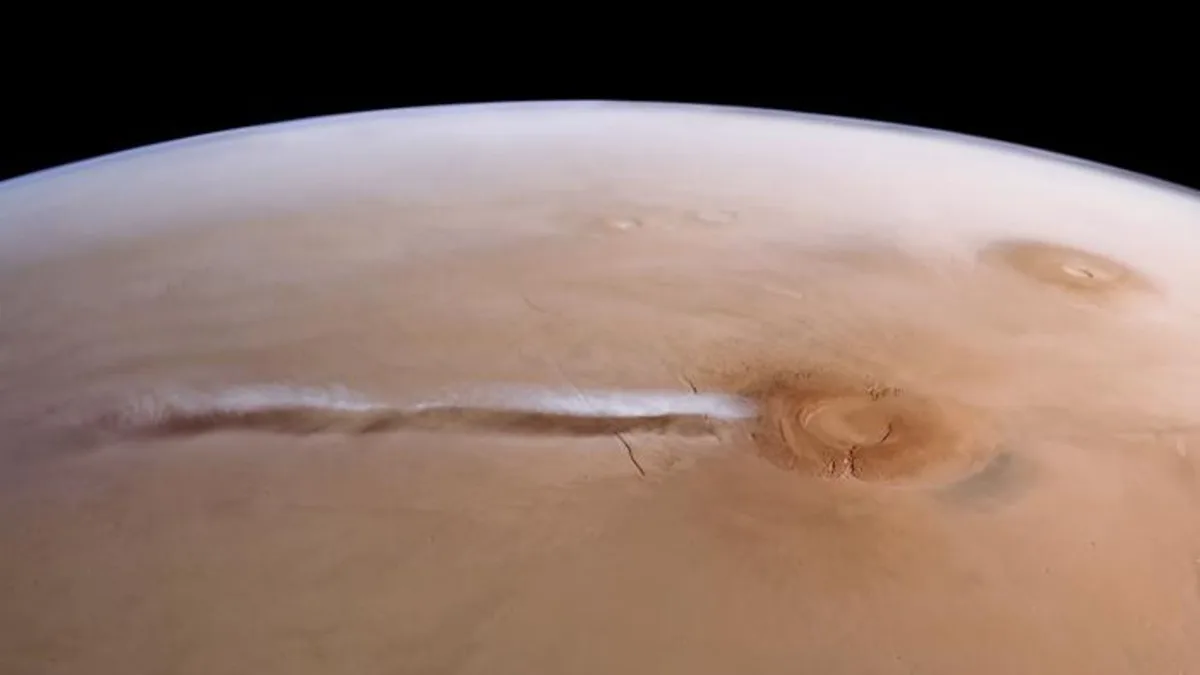
A 1,000-mile-long (1,600 kilometers) Martian cloud that emerges and then quickly disappears from the Red Planet's sky nearly every day is even weirder than scientists realized.
New simulations suggest that the eerie apparition can only be explained using "exotic physics" that have been theorized but never seen on Earth or anywhere else in the solar system .
The mysterious floating mass, dubbed the Arsia Mons Elongated Cloud (AMEC), frequently emerges above Arsia Mons , a 12-mile-tall (20 km) extinct volcano located in the Tharsis region , just south of the Red Planet's equator.
The water vapor cloud was first spotted in 2018 by the European Space Agency's Mars Express orbiter and has since appeared nearly every morning throughout Mars' spring and summer, when increased solar radiation triggers strong surface winds.
But it lasts only a few hours each day, before fully evaporating.
The AMEC can stretch up to 1,100 miles (1,800 km) long, around one-twelfth of Mars' circumference.
For context, that is roughly twice the length of the U.K. or the distance between New York City and Miami.
Although the Red Planet is no stranger to giant dust clouds and occasional "iridescent streaks" of carbon dioxide , it is almost completely devoid of atmospheric water vapor.
That makes it extremely rare for puffy, Earth-like clouds to form there, let alone ones so vast.
As a result, scientists have struggled to explain this whacky weather.
But in a new study published Wednesday (Oct.
7) in the journal Nature Geoscience , researchers used Mars Express data to create new simulations in an effort to finally explain the AMEC.
Initially, the team struggled to recreate the puzzling phenomenon.
But when they abandoned traditional meteorological principles in favor of a more out-of-the-box explanation, they were eventually successful.
5News aggregated this summary from the outlet’s public feed. The full article, with all the context, is on www.livescience.com — the content belongs to Live Science.