Young wild octopuses may form a 'fight club' and slap territorial fish if they get too close
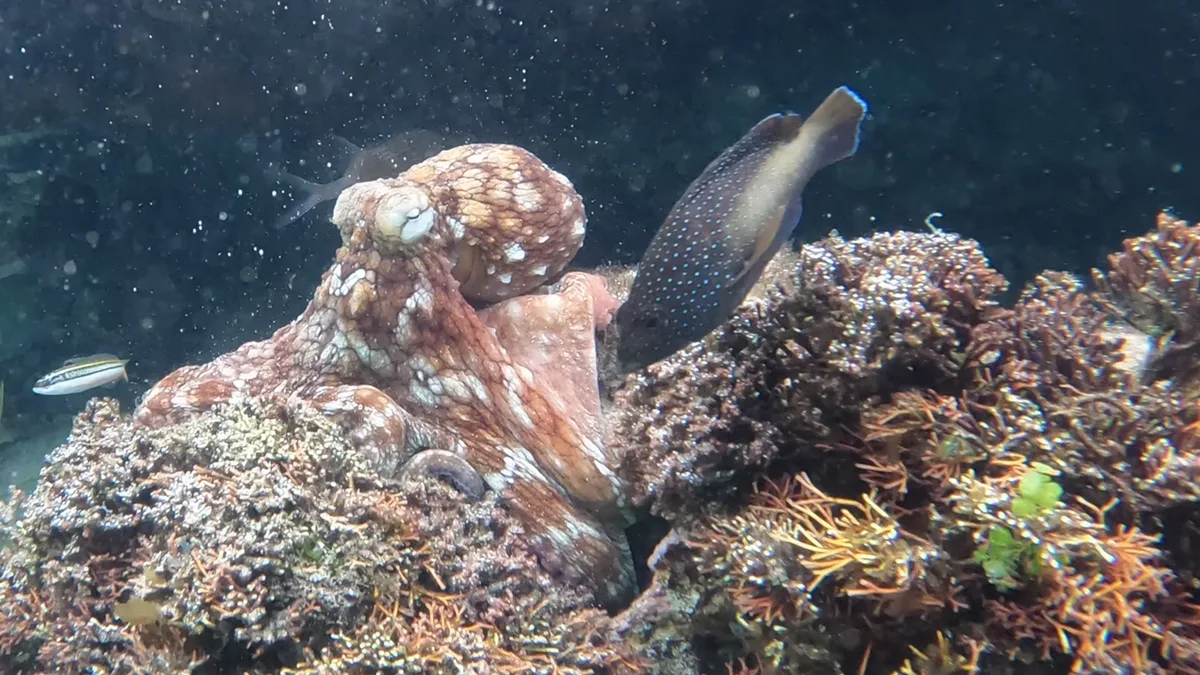
Octopuses are known to smack fish when they get too close.
But while it might seem unsporting for an animal with eight arms to start a boxing match with an animal that has none, new research shows that octopuses don't just lash out indiscriminately; instead, they slap certain fish species that "jab" and "swipe" at the octopuses in a squabble over territory.
These marine fight clubs show that octopuses' aggressive behavior is part of a more complicated set of responses than previously thought, the scientists said in the new study.
The researchers observed 101 interactions between juvenile Brazilian reef octopuses ( Octopus insularis ) and 10 species of reef fish in shallow waters along the northeastern coast of Brazil and on oceanic islands.
The encounters revealed that the young octopuses didn't respond to every fish in the same way.
Territorial fish that appeared to defend their territory from the octopuses triggered rapid, defensive reactions, including the "slap" arm movement.
But nonterritorial fish that followed the octopuses as they hunted tended to produce longer, less-confrontational encounters in which the octopuses simply continued foraging.
The findings, published July 31 in the journal Behavioural Processes , add to decades of observations of interactions between octopuses and fish by showing how juvenile O. insularis adjust their actions depending on the behavior of the fish they encounter.
"Clearly there's not one way at which they're interacting," said study co-author Jennifer Mather , a recently retired octopus behavior researcher at the University of Lethbridge in Alberta.
"The territorial fish are really going to do one thing, and the nonterritorial fish are doing other things," she told Live Science.
Different fish, different response The researchers recorded 38 juvenile octopuses interacting with fish, splitting the encounters into those involving territorial species, like damselfish (family Pomacentridae) and nonterritorial species, like blue tang ( Acanthurus coeruleus ).
The difference was striking.
Interactions with territorial fish lasted an average of about 14 seconds and tended to involve rapid changes in behavior.
The fish performed "jabs" and "swipes" as they tried to attack the octopuses, while the octopuses responded with "flinches" and arm "slaps." Interactions with nonterritorial fish lasted much longer, averaging about 46 seconds.
5News aggregated this summary from the outlet’s public feed. The full article, with all the context, is on www.livescience.com — the content belongs to Live Science.