Does tapping on a soda can really stop it from exploding?
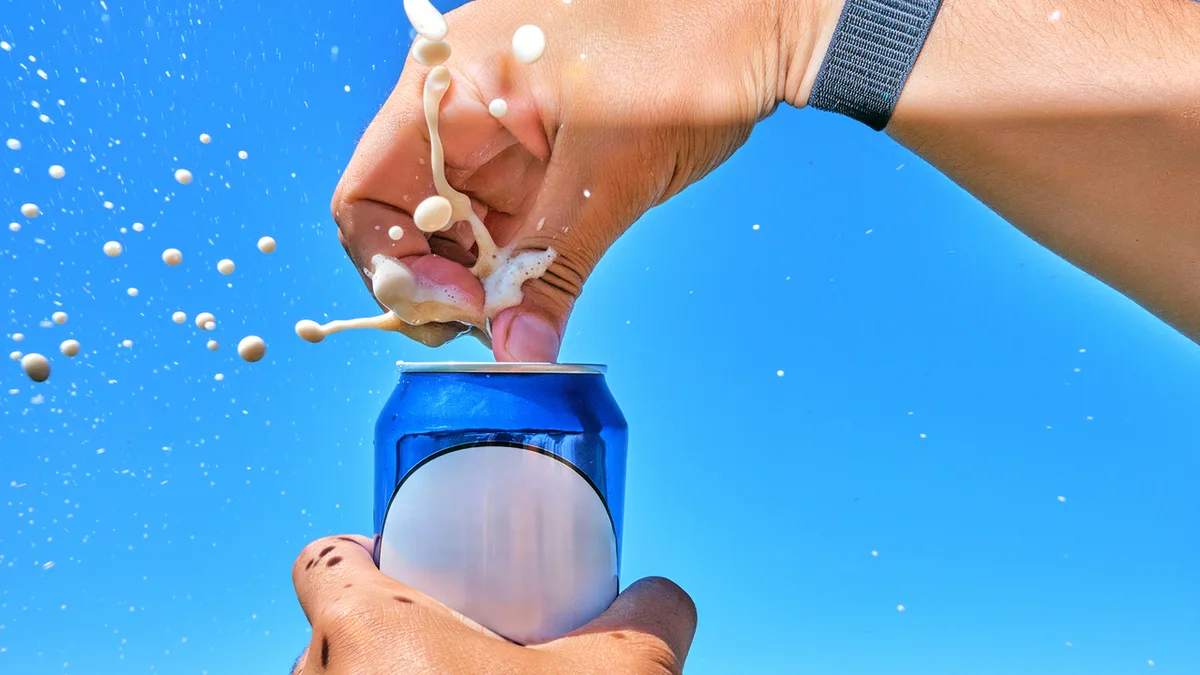
We all know that a dropped or shaken soda can comes with the risk of a fizzy eruption.
People use different techniques to prevent these bubbly blasts, including tapping the top of the can.
This advice has been passed around for years, but does it actually work? The answer lies in the physics of what's happening inside the can.
Building the bubbles To make a carbonated drink, carbon dioxide is injected into the liquid — such as soda, beer or Champagne — at a high pressure and cold temperature.
"[Bubbles] are formed as a result of what is called supersaturation of carbon dioxide," Roberto Zenit , a professor of engineering at Brown University who studies fluid mechanics, told Live Science.
Supersaturation is an unstable state where a liquid or gas can hold more dissolved materials than normal conditions allow.
Thanks to its instability, there are some actions, like shaking a can, that can encourage more bubble production.
Sign up for our newsletter (Image credit: Marilyn Perkins / Future) Sign up for our weekly Life's Little Mysteries newsletter to get the latest mysteries before they appear online.
"The mechanical action (tapping or shaking) generates violent pressure waves inside the liquid; these waves rebound at the walls, creating low-pressure zones where tiny bubbles form," Javier Rodríguez Rodríguez , an associate professor of fluid mechanics at Carlos III University of Madrid, told Live Science in an email.
"If given enough time (minutes to tens of minutes, depending on the drink and container), these bubbles dissolve again and the can 'forgets' that it has been perturbed." However, if the soda can is open while the bubbles are suspended in the liquid, the sudden pressure drop from opening the can encourages more bubble production, resulting in more spillover, Rodríguez Rodríguez said.
In some rare cases, like spraying Champagne after a NASCAR victory , creating a geyser of foam is exactly the goal, which the drivers accomplish by vigorously shaking the bottles beforehand.
Does tapping actually work? Unlike NASCAR drivers, most people are looking to save their drink, so they may try tapping the top of the can.
The idea behind this strategy has some merit.
According to Zenit, carbon dioxide bubbles can expand out of tiny imperfections called nucleation sites , which can include dust particles or rough spots on the can.
5News aggregated this summary from the outlet’s public feed. The full article, with all the context, is on www.livescience.com — the content belongs to Live Science.