James Webb telescope just spotted the oldest, closest pair of black holes in the early universe
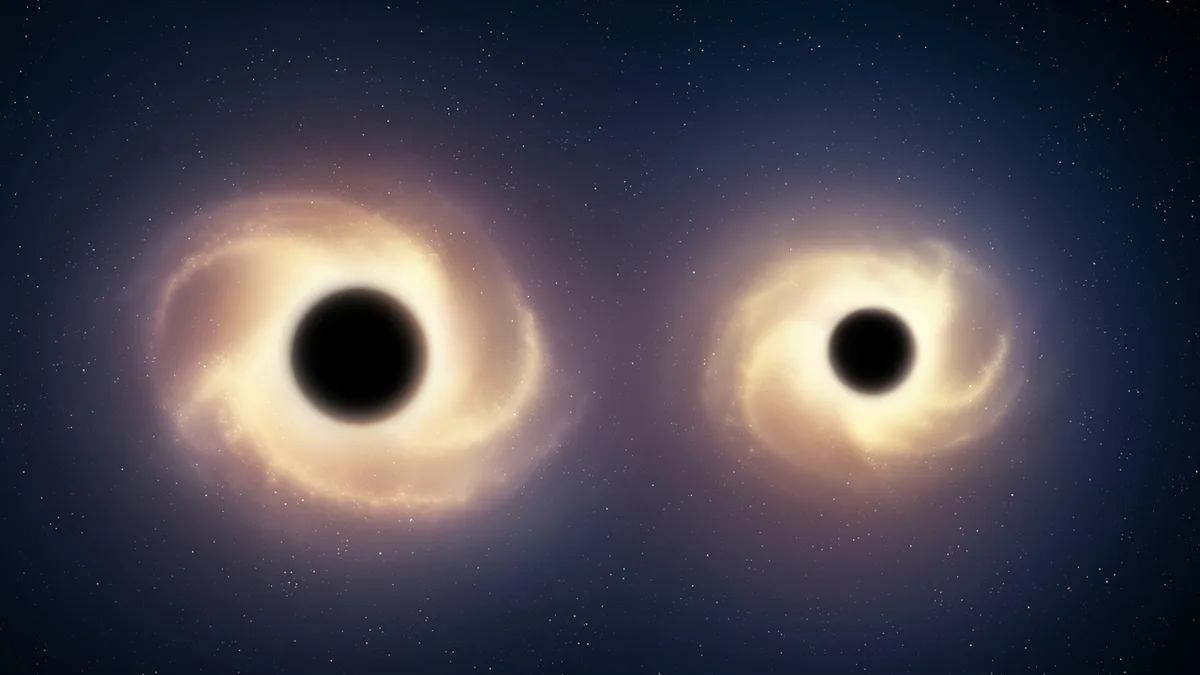
Astronomers have discovered a close pair of actively feeding supermassive black holes, seen when the universe was just 1.3 billion years old.
Collectively known as LID-1166, the two monsters are separated by only about 4,900 light-years (1.5 kiloparsecs) inside a merging galaxy, offering the first clear view of a phase that's critical for understanding the growth of supermassive black holes.
Most large galaxies we can see formed over billions of years by merging with other galaxies.
Most galaxies also have central black holes , so a merger between them would produce a system with two black holes.
These "dual black hole" systems are thought to be common in the early universe.
However, given that they're buried in dense gas and dust, these black holes are too close to be observed separately.
In a new study uploaded to the arXiv preprint server July 21, Hyewon Suh , an astronomer at the International Gemini Observatory/NSF NOIRLab, and colleagues reported the discovery of the closest-together dual black hole system ever confirmed this early in the universe's history.
The team used the James Webb Space Telescope (JWST) and the Atacama Large Millimeter/submillimeter Array (ALMA), a collection of radio telescopes in Chile, to study this system.
The paper has been accepted for publication in the journal Nature Astronomy.
"What makes that discovery special is that we may be seeing these two black holes growing and interacting in a system that is only about 1.3 billion years after the Big Bang," Anna Trindade Falcão , an astrophysicist at NASA's Goddard Space Flight Center who was not involved in the study, told Live Science.
A distant "close" pair LID-1166 first caught the astronomers' eyes as an X-ray source in the Chandra COSMOS Legacy Survey, but it remained completely undetected in even the deepest Hubble Space Telescope images.
The strong X-ray signal hinted at the powerful feeding activity.
To understand what was producing these strong emissions, the team turned to JWST's Near-Infrared Spectograph (NIRSpec) instrument, which revealed two compact, glowing sources sitting 4,900 light years apart.
Although astronomers have spotted other dual black hole candidates even earlier in the history of the cosmos, those pairs were separated by tens of thousands of light-years or more.
5News aggregated this summary from the outlet’s public feed. The full article, with all the context, is on www.livescience.com — the content belongs to Live Science.