Did the Vikings really shoot fiery arrows at funeral boats?
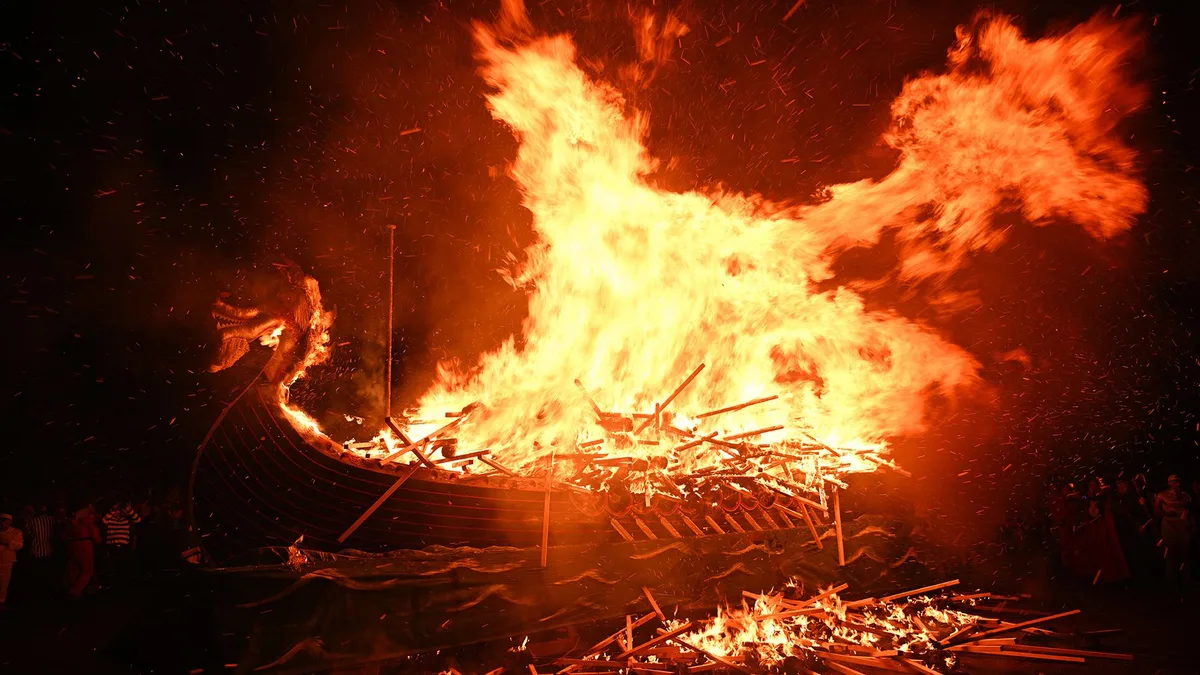
In movies and TV shows, it's a popular motif: A dead Viking is placed on a boat, and it drifts slowly out to sea; from land, an archer shoots a fiery arrow that falls onto the boat and engulfs it in flames.
It's been seen in the 1958 movie " The Vikings ," the History Channel show "Vikings" and fantasy series such as " Game of Thrones ." But did the Vikings actually do this? To find out, we asked experts whether there is any archaeological or historical evidence to support the idea.
Archaeological evidence Sign up for our newsletter Sign up for our weekly Life's Little Mysteries newsletter to get the latest mysteries before they appear online.
Our sources noted that a burial like this would leave little archaeological evidence.
Such "practices would leave little trace, and they are unverified by archaeological sources," Howard Williams , an archaeology professor at the University of Chester in the U.K., said in an email.
Erin McGuire , an anthropology professor at the University of Victoria in Canada, also noted this limitation.
From "an archaeological standpoint, we have no evidence for this very common motif," McGuire told Live Science in an email, adding that it would be hard to differentiate a fire set by a fire arrow from a regular fire.
Additionally, shipwrecks "with human remains are very, very rare globally," McGuire added.
"It takes particular kinds of environmental conditions for them to be preserved and I know of none from the Viking Age." The Gokstad Viking ship from Norway, which dates back more than 1,100 years ago. (Image credit: Francesco Bonino via Alamy) However, the Vikings were master seafarers and frequently cremated their dead.
And there is evidence that Vikings burned ships, McGuire noted.
We "do have archaeological examples of ships and parts of ships that were burnt during funerary practices while still on land and were buried after being burned," McGuire said.
These include the ninth-century Myklebust ship , a burnt Viking ship that was found in a burial mound in Norway and was built for a rich person, possibly a king.
Historical evidence and legends Perhaps the closest historical evidence for the fire-arrow ritual comes from Ahmad ibn Fadlan, a 10th-century Arab traveler who went to the Volga River in what is now Russia and spent time with Viking groups there.
In ibn Fadlan's written account, a Viking chieftain is placed on a boat, which is set ablaze.
5News aggregated this summary from the outlet’s public feed. The full article, with all the context, is on www.livescience.com — the content belongs to Live Science.