AI music lawsuits raise questions about American companies and Canadian arts
A Canadian non-profit performance rights organization is suing Suno, an American genAI music creation platform, over streaming AI outputs that allegedly replicate songs without consent or compensation.
The Society of Composers, Authors and Music Publishers of Canada (SOCAN) lawsuit cites 150 Suno songs that it says are identical or nearly identical to the works of Canadian artists including Joni Mitchell, The Weeknd, The Tragically Hip and others.
SOCAN wants the AI company to comply with copyright law and for artists to have a say in how their works are used (or not).
The statement of claim , which seeks $20,000 per work and $10,000,000 for infringement, joins a series of recent lawsuits against Suno.
These include a US$500-million joint copyright lawsuit originally launched by major labels of Warner, Sony and Universal ( Warner has since signed a licensing deal with Suno ) and a class-action lawsuit from Jason Isbell and other musicians .
There are also music publisher and record label lawsuits.
SOCAN’s lawsuit raises questions about the place of Canadian artists in a music industry increasingly shaped by American tech companies.
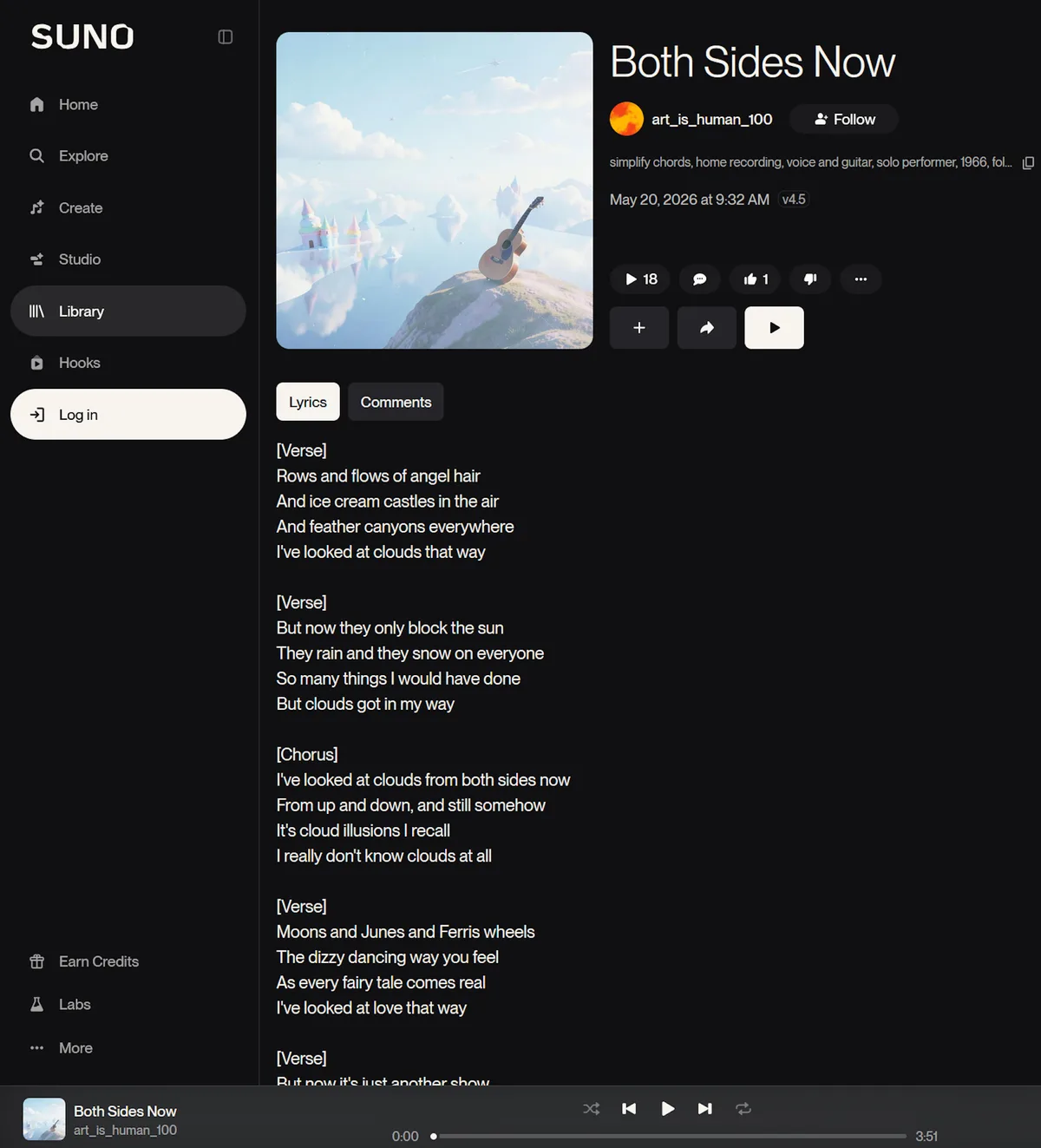
SOCAN’s complaint says in response to a prompt consisting of lyrics to ‘Both Sides Now’ by Joni Mitchell, Suno generated an output that is virtually identical including in melody, harmony and lyrics. (SUNO) Musician livelihoods at risk A wide range of issues pertaining to AI technology and musicmaking are putting musician livelihoods at risk.
“It definitely feels like an existential struggle for artists today against AI,” rapper Cadence Weapon told The Canadian Press .
The artist says 129 of his songs have been found in datasets to train AI music generators.
We conducted a survey this past summer with 267 working musicians in Canada .
The survey was sent to 1,025 musicians ( Polaris-longlisted artists between 2006-25 who have appeared on the Earshot charts seven or more times with Gold records; some were added for geographic representation).
We asked 26 questions about their music-making and relationships to aspects of the music industry, including companies like Spotify, Live Nation and Suno.
Read more: Artists’ Spotify criticisms point to larger ways musicians lose with streaming — here’s 3 changes to help in Canada Musician responses We found that 87 per cent of respondents view AI technology in music creation negatively.
5News aggregated this summary from the outlet’s public feed. The full article, with all the context, is on theconversation.com — the content belongs to The Conversation Canada.