Experts: What makes the Gyirong Port rescue so difficult?
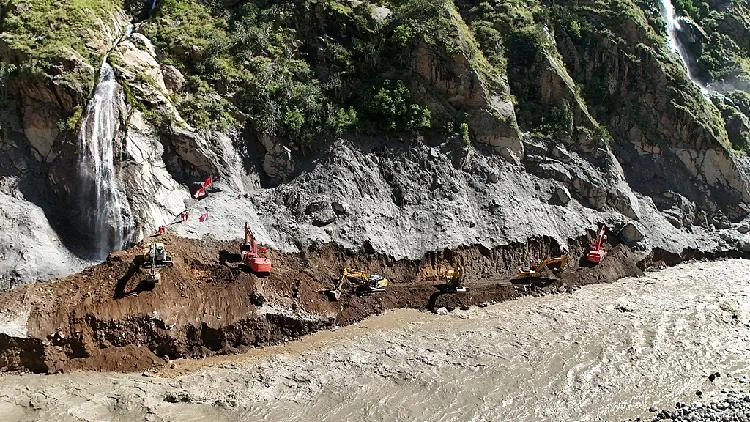
A massive mudslide triggered by a glacier collapse in Nepal struck Gyirong Port in southwest China's Xizang Autonomous Region on August 26.
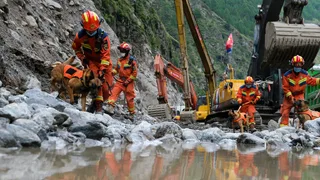
Rescue teams are racing against time to search for the missing, clear debris and monitor the barrier lake.
But the operation is exceptionally difficult.
What makes the rescue at Gyirong Port so challenging? A cascading disaster with extraordinary destructive force This was far more than an ordinary mudslide.
An ice-rock avalanche at an altitude of about 5,200 meters in Nepal swept down more than 3,000 meters toward Gyirong Port, which sits at an elevation of about 1,800 to 2,000 meters.
Along the way, it picked up huge amounts of loose material, forming a high-speed debris flow that eventually swept into Gyirong Port.
The resulting ice-rock debris flow traveled about 22 kilometers at an average speed of around 50 meters per second, according to Liu Weiming, a researcher at the Institute of Mountain Hazards and Environment under the Chinese Academy of Sciences and the Ministry of Water Resources.
Rescuers are not dealing with simply "a flow of mud and water." Instead, they are confronting a cascading process in which each stage of the disaster intensified the next, said Dai Zili, deputy secretary-general of the International Consortium on Geo-disaster Reduction.
As the ice and rock moved down the valley, they eroded the surrounding slopes and swept up loose deposits that had accumulated in the mountains.
More than 30 million cubic meters of material was ultimately involved, Dai noted.
The surrounding mountains further concentrated the energy.
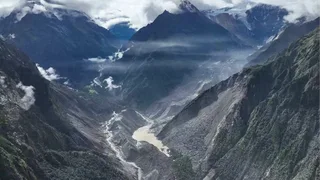
Confined by steep, V-shaped valleys, the debris had little room to spread sideways and instead surged rapidly downstream, concentrating its destructive force along the valley.
Steep mountains, narrow valleys leave little room for rescue Gyirong Port is surrounded by steep mountains and narrow valleys.
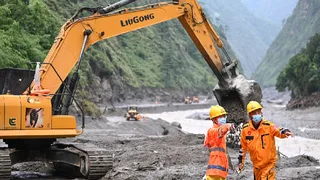
Heavy machinery can only advance along the valley, while search operations, road repairs and disaster monitoring have to take place within the same confined space.
此摘要由5News从媒体的公开信息源汇聚而成。 包含完整背景的全文在www.cgtn.com — 内容归CGTN Nature (oficial)所有。