When National Theatre brought cinema to the western suburbs of the city
Account subscription benefits alongside Premium Stories, Editorials, Opinions and more. Unlock these with Subscription
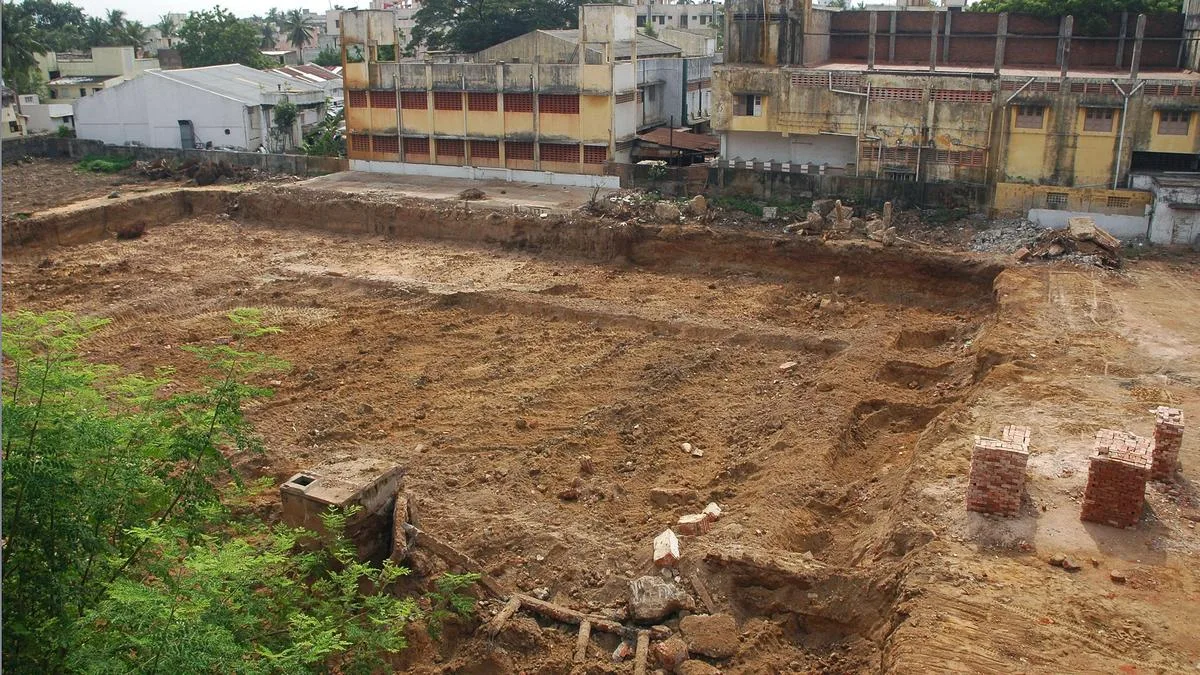
The site of the old National Theatre at Virugambakkam, when it was making way for a state-of-the-art multiplex-cum-shopping mall | Photo Credit: S.S. Kumar
National Theatre stood on Arcot Road in Virugambakkam at a time when the western parts of Madras — particularly the Kodambakkam-Vadapalani-Saligramam belt — were emerging as the heart of the city’s film industry. The neighbourhood was dotted with major studios such as AVM, Vijaya-Vauhini and Prasad, and had become closely associated with the growth of Tamil cinema.
Against this backdrop, National Theatre offered a more modern cinema-going experience. By the 1960s, it was equipped with a Bauer B.14 Klang film sound system and a Perlex panoramic screen.
Virugambakkam itself was a very different place then, says G. Ramakrishnan, a long-time resident. Before becoming part of the Madras Corporation in the late 1970s, Virugambakkam retained much of its rural character with agricultural fields and mango groves. Small lakes and ponds sustained stretches of farmland, homes were few and far between, and basic civic infrastructure was limited, he says.
Ravi Subramanian, now a resident of Adelaide, Australia, and community advisory council member, Diabetes Australia, remembers walking to the theatre from his home in Arumbakkam to watch a movie.
“There was no pucca road. After sunset, the absence of streetlights left the vast stretches of unpaved roads and open land almost completely dark. Around that time, within Arumbakkam, we had something called Touring Talkies. It was a temporary theatre, also known as a tent theatre, with no permanent infrastructure. Patrons sat on the floor over a spread of sand. It was mostly occupied by working-class people from Arumbakkam and the Koyambedu villages,” he recalled.
National Theatre, he said, represented a considerable step up, offering better acoustics, picture quality and seating. As more families moved into Virugambakkam and neighbouring areas, the theatre became an important destination for the growing residential population.
“The pathway from Arumbakkam Jagannath Nagar to National Theatre was through semi-jungle-like vegetation, consisting of thorny bushes. Occasionally, stray dogs would bark at strangers walking along the paths,” Mr. Subramanian said.
The theatre was part of a larger enterprise built by National Company, founded by N. Munusamy Mudaliar. Mr. Mudaliar began his career in the early 1940s as a maintenance worker repairing and replacing plumbing lines in government buildings, including Raj Bhavan. He subsequently began taking up PWD contracts and established National Company, which was formally registered as a PWD contractor in 1954.
The company later undertook several government projects, says Gopalakrishnan Venkateswaran, who worked for the company’s auditors.
National Company eventually expanded beyond civil contracting and owned and operated two theatres — one in Tambaram and the other in Virugambakkam. Both were constructed by the company.
5News aggregated this summary from the outlet’s public feed. The full article, with all the context, is on www.thehindu.com — the content belongs to The Hindu.