My favorite thing in the night sky appears on Aug. 28 — and it proves Earth is a sphere
What's your favorite thing in the night sky? Maybe it's the Pleiades, that sparkling open cluster that dominates winter in the Northern Hemisphere.
Perhaps it's a sight of the Milky Way arching across the summer sky.
Or could it be Saturn, a close-up sight of which has many people reaching for their wallets to buy a bigger telescope.
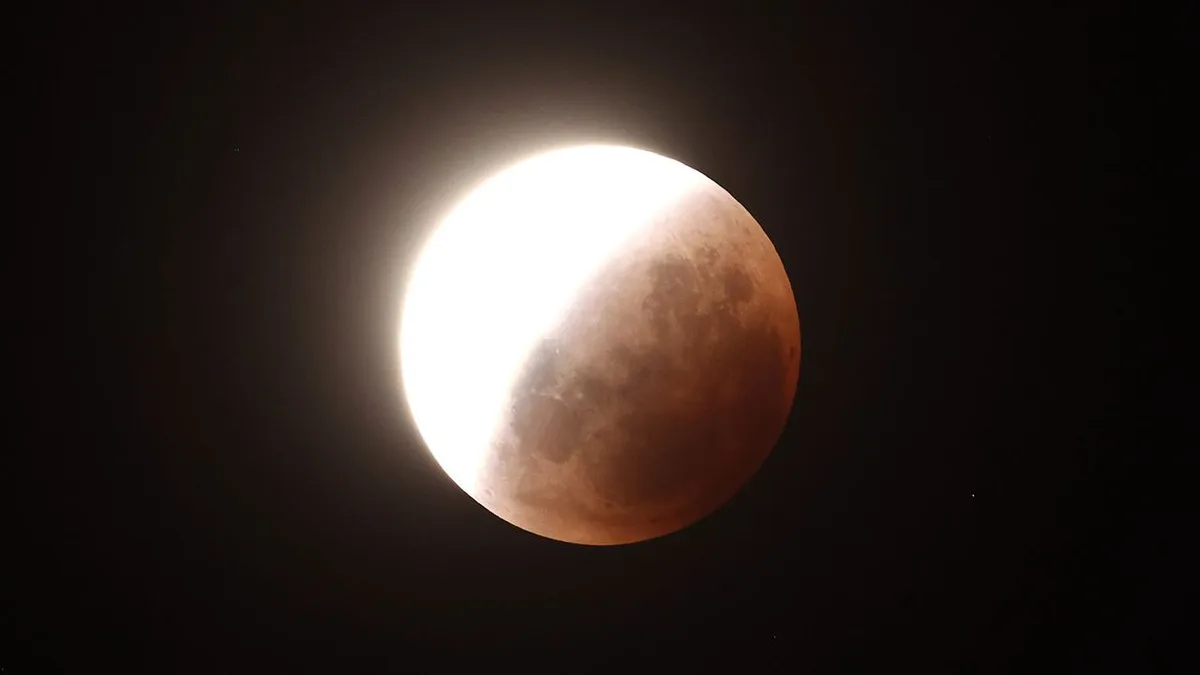
My favorite sight? It's us or, rather, our shadow.
It's something that's only observable during a partial lunar eclipse — and there's one coming up very soon.
Overnight on Aug.
27-28 , an unusually deep partial lunar eclipse will be visible across Europe and North America, during which I will be watching Earth's shadow do something spectacular for precisely 3 hours, 18 minutes and 5 seconds.
A lunar eclipse happens when the sun, Earth and a full moon — in this case, August's Sturgeon Moon — line up closely enough for the moon to pass through Earth's shadow, a vast cone of darkness stretching away into space.
Because the sun is a disk rather than a point of light, Earth's shadow tapers as it travels, narrowing like the beam of a flashlight in reverse.
It creates two distinct shadows: Umbra: its dark inner section, which extends roughly 870,000 miles (1.4 million kilometers) into space, four times farther than the moon.
Earth passes through it during a partial and total lunar eclipse.
Penumbra: a paler outer shadow where Earth blocks only part of the sun.
During a penumbral eclipse, the moon merely brushes this outer zone and often appears only subtly dimmed.
Those shadows create, in turn, three phases — penumbral, partial and total — as the moon passes through Earth's shadow.
5News aggregated this summary from the outlet’s public feed. The full article, with all the context, is on www.space.com — the content belongs to Space.com.