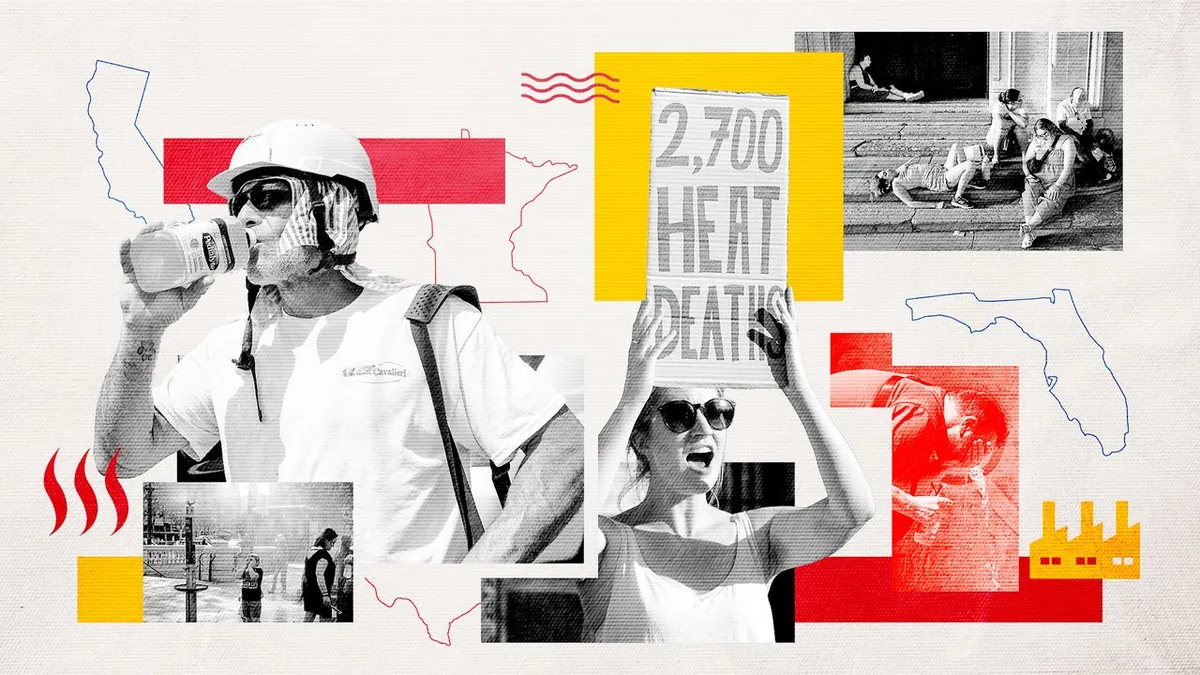
Climate change will triple the number of days over 105 F in the US. The health impacts will be dire.
In 2010, researchers at Purdue University and the University of New South Wales began an investigation into a macabre question: What's the upper temperature limit at which humans can survive? The answer, according to their calculations, was 95 degrees Fahrenheit (35 degrees Celsius) at 100% humidity — a "wet bulb" temperature that sets an absolute "unsurvivable" threshold for the human body.
Beyond this temperature, a cascade of irreversible physiological processes begins, sending organs into shock, causing blood to clot and ending in inevitable death.
As the climate warms and heat waves multiply, more places across the globe are creeping towards this threshold, with climate models projecting the first 35 C wet bulb temperatures by the middle of the century .
But conditions don't have to be this hot or humid to be unlivable in a practical sense for wide swaths of the population.
The threshold is lower for those who are older, for women, and those with certain medical conditions.
Any kind of physical activity also raises the risk of heat stress.
In some parts of Asia, South America and Australia, the hottest days are already " unlivable ," meaning a healthy adult sitting in the shade in a slight breeze could be at risk from heat illness, a recent study found.
A heat dome hit the western U.S. on July 12, 2026, air temperature data from the GEOS (Goddard Earth Observing System) revealed.
Numerous weather stations in Utah, Montana and Wyoming recorded their highest temperatures since record-keeping began.
Such heat waves will become more common as the climate warms. (Image credit: NASA Earth Observatory/Michala Garrison) In North America, the hottest days in parts of the Southwest and Southeast pose that same risk, the study found.
And more heat is coming: Under projected warming, the country will see tens of thousands more heat-related deaths by 2100.
Nearly 20,000 people could die from extreme heat each year by the middle of the century in the United States.
The U.S. and Mexico could see an additional 9,000 suicides each year.
Heat can kill directly, via heat stroke, but it can also worsen underlying cardiovascular health, turning chronic, manageable heart conditions deadly.
5News aggregated this summary from the outlet’s public feed. The full article, with all the context, is on www.livescience.com — the content belongs to Live Science.