Black hole star? Solar-system-size 'dot' from the early universe is our best evidence yet of a brand-new type of cosmic object
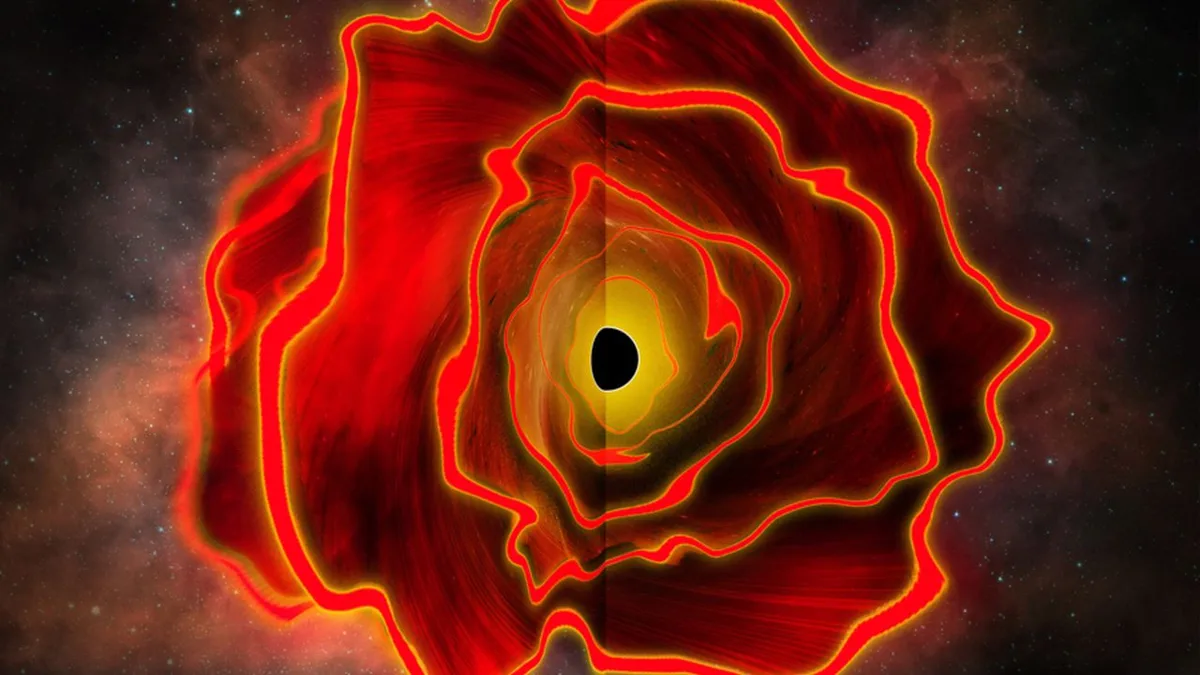
Astronomers have found the most promising candidate yet for a "black hole star," a new type of astrophysical object lurking in the early universe's "cosmic dawn." If confirmed, the findings could help to unravel the mysterious origin of " little red dots " (LRDs), an infamous group of hundreds of distant, crimson lights spotted by the James Webb Space Telescope (JWST).
These dots, which are almost as old as the universe itself, shine much brighter than stars but are too dim to be fully formed galaxies, making them one of the biggest puzzles in modern astronomy .
The newly discovered dot, which is around the size of our solar system , was spotted by JWST's Miracle or Mirage (MoM) survey, which scours the night sky for far-off galaxies .
The reddish light JWST detected was emitted about 660 million years after the Big Bang, when the universe was approximately one-twentieth its current age, and it is roughly 100 billion times brighter than a typical star, researchers reported in a new study, published Aug.
12 in the journal Nature .
The researchers propose that this dot is a black hole star — an enormous, hypothetical ball of dense gas that surrounds and is superheated by a giant black hole .
They've named it MoM-BH*-1, combining the survey that found it with the moniker "black hole star one." "Our picture of this object is evolving very rapidly," study first author Rohan Naidu , an astronomer at the University of Hawaii and a former NASA Hubble fellow at MIT, said in a statement from MIT .
It is "truly singular in so many ways," he added.
The James Webb Space Telescope spotted the new object as part of its Miracle or Mirage survey, which recently discovered the most distant known galaxy. (Image credit: Getty Images) This is not the first proposed black hole star.
Last year, a study that included many of the same authors identified a black hole star candidate dubbed "the Cliff," which displayed many similar characteristics as MoM-BH*-1 .
However, the team believes the latest find is "our best evidence" of this never-before-seen cosmic object, the researchers said in a separate statement from the Institute of Science and Technology Austria.
MoM-BH*-1 is farther away from us (and therefore older) than the Cliff, making it even more important for understanding how these newly revealed objects form.
Following cosmic clues The first clue that MoM-BH*-1 was unusual was its striking ruby hue; it is redder than many other LRDs.
"When we see something very red in the universe, we often assume that it is surrounded by dust," study co-author Robert Simcoe , director of MIT's Kavli Institute for Astrophysics and Space Research, said in the MIT statement.
5News aggregated this summary from the outlet’s public feed. The full article, with all the context, is on www.livescience.com — the content belongs to Live Science.