Fossils of iconic long-necked dinosaur Diplodocus found in Europe for first time — and it may have traveled there via land bridge
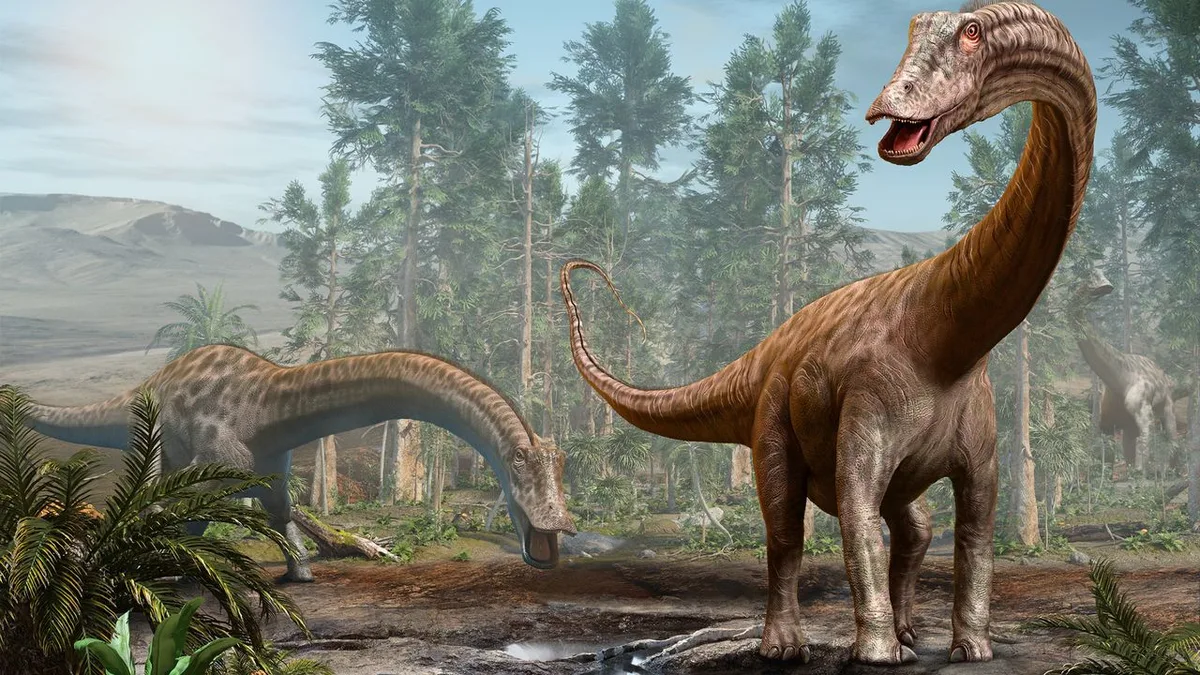
Paleontologists have identified the first confirmed remains of Diplodocus — "Dippy," for short — outside the western U.S., revealing that the iconic long-necked dinosaur reached what is now Spain roughly 150 million years ago.
The findings show that the enormous sauropod didn't live only in North America, as was long thought.
Instead, it may have rambled across a land bridge all the way to Europe, the new study suggests.
The discovery, made at the La Tejería site near the small village of El Castellar in eastern Spain, provides some of the strongest fossil evidence yet that dinosaurs could move between North America and Europe during the Late Jurassic, when the Atlantic Ocean was still in its early stages of opening after the breakup of the supercontinent Pangaea.
The researchers published their findings Tuesday (Sept.
15) in the Journal of Vertebrate Paleontology .
"Paleontological studies like this one help us better understand the history of life on Earth, reconstruct ancient ecosystems, and understand how they changed through time," study first author Sergio Sánchez Fenollosa , a doctoral student who studies biodiversity and evolutionary biology at the Joint Paleontology Foundation Teruel-Dinópolis (Dinópolis Foundation), a paleontological research institution, told Live Science via email.
A sauropod in Spain Dippy is one of the best-known dinosaurs.
After its fossils made their grand debut at the Carnegie Museum of Natural History in Pittsburgh in the early 1900s, life-size fossil replicas of the towering herbivore were sent around the world , including to England, France, Spain, Argentina and Russia.
But until now, Diplodocus ' Late Jurassic fossils were known only from the Morrison Formation in the western United States — and the latest discovery shows that Dippy wasn't a homebody.
The newly unearthed Diplodocus specimen consists of 14 well-preserved tail vertebrae and several chevrons — bones that helped support blood vessels and muscles within the dinosaur's tail.
Study co-author and managing director of the Dinópolis Foundation, Alberto Cobos , said it was a friend who "thought he had spotted some bones on a mountainside," Cobos told Live Science via email.
"That very day, I went to the site near El Castellar (a village in the province of Teruel).
Sure enough, we saw a couple of sauropod vertebral centers." Although only part of the skeleton has been recovered, the bones show a series of characteristics associated with Diplodocus, including large cavities corresponding to where air sacs would have been, along with deep grooves running alongside the underside of the tailbones.
5News aggregated this summary from the outlet’s public feed. The full article, with all the context, is on www.livescience.com — the content belongs to Live Science.