Earth's first bats didn't come from where we thought, landmark genetic study reveals
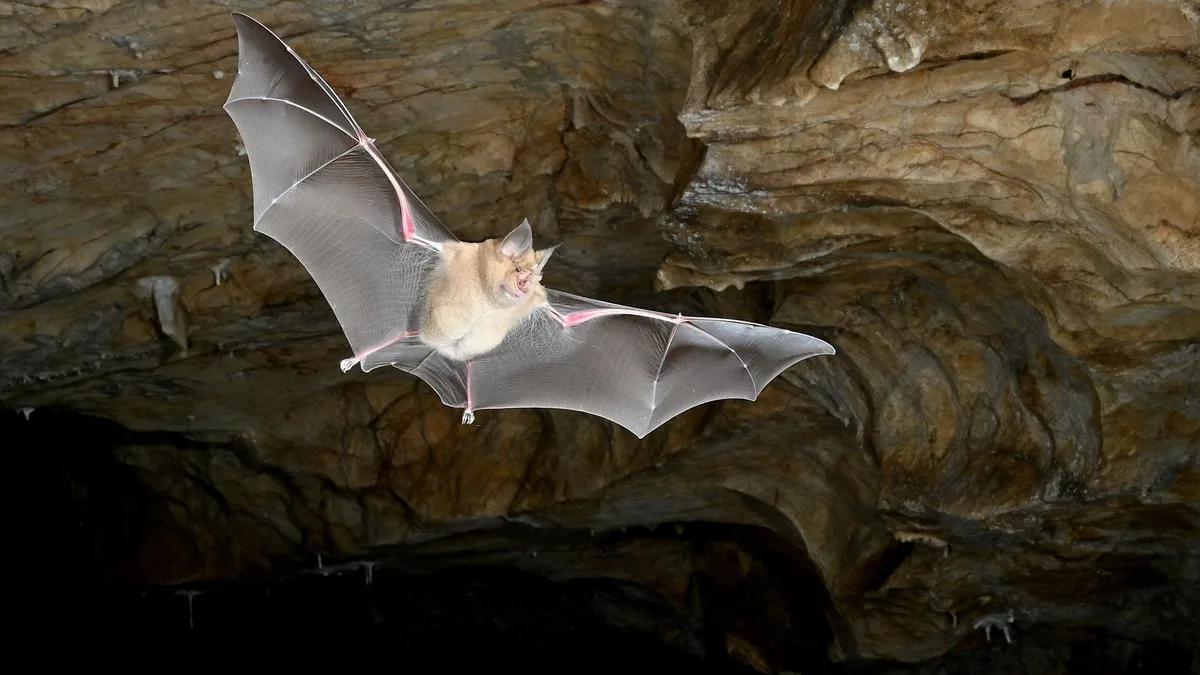
Scientists may have settled a decades-long debate about bat evolution, including controversial questions about when bats began to communicate and fly, a landmark study shows.
The new research, published Wednesday (Sept.
23) in the journal Nature , is the biggest bat DNA and fossil study ever conducted.
Researchers created new, top-quality genome assemblies for 41 bat species, which they analyzed together with 62 existing sequences, providing a record dataset of 103 bat genomes and 44 bat fossils.
"It is extraordinary," study co-author Emma Teeling , a professor of molecular evolution and mammalian phylogenetics at University College Dublin, told Live Science in an email; "after decades of research and conflicting findings, we finally have uncovered how and when bats evolved." The analysis suggests that bats arose in Europe around 65 million years ago, contradicting previous hypotheses proposing Asian , African or North American origins around 50 million years ago.
Additionally, the researchers found that echolocation and true flight evolved early in bats, roughly 50 million years ago, rather than multiple times after modern bats began to diversify.
"This study transforms bat evolution research because it finally gives us a robust, resolved family tree and biogeography, something that's eluded scientists for decades," study co-author Sonja Vernes , a professor and head of the Neurogenetics of Vocal Communication Research Group at the University of St Andrews in the U.K., told Live Science in an email.
"Get the tree right, and everything else about bat evolution starts to fall into place." The study included members of all 21 recognized bat families, as well as some of the most remarkable bat species known on Earth.
For example, the dataset contained the bumblebee bat ( Craseonycteris thonglongyai , also called the Kitti's hog-nosed bat), which, at about 1 inch, or 2.5 centimeters, long, is thought to be the smallest mammal on Earth; and the Madagascar's sucker-footed bat ( Myzopoda aurita ), which has suction cups on its wrists and ankles to help it cling to smooth surfaces.
The research team — which comprised 137 scientists affiliated with Bat1K , an international project to map the genomes of all living bat species — used advanced DNA sequencing and computational techniques to identify individual genes and redraw the bat family tree.
"The value we bring is in innovative methods and unparalleled data that together yield an evolutionary tree that includes all these key fossils," study co-author Liliana Dávalos , a professor of phylogenetics and tropical deforestation at Stony Brook University in New York, told Live Science in an email.
5News aggregated this summary from the outlet’s public feed. The full article, with all the context, is on www.livescience.com — the content belongs to Live Science.