A surprising slab of salt shines at the summit of the Sahara's tallest peak — Earth from space
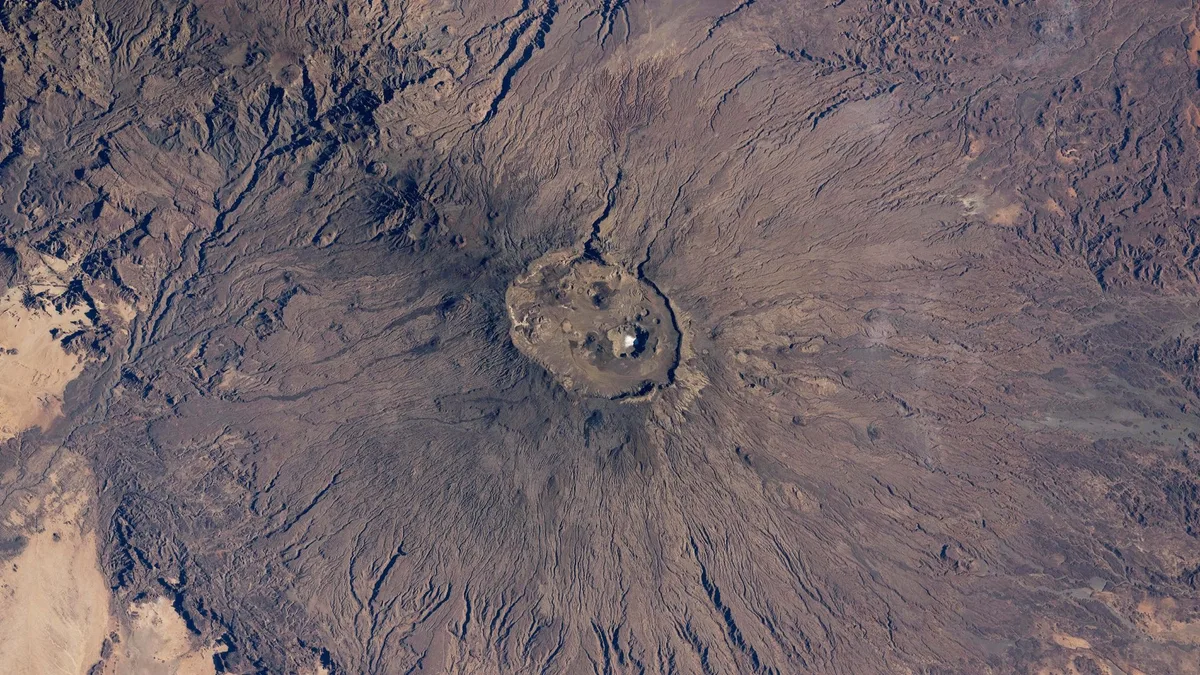
QUICK FACTS Where is it? Emi Koussi, Chad [ 19.825520656, 18.551560720 ] What's in the photo? A patch of bright-white salt at the summit of the Sahara's tallest volcano Who took the photo? An unnamed astronaut on board the International Space Station When was it taken? Dec.
29, 2024 This intriguing astronaut photo shows a bright-white, salty surprise lurking at the summit of a giant volcano in the Sahara.
The ancient, lava-covered peak also holds hidden, shadowy waterways, despite its extremely arid environment.
Emi Koussi (also known as Emi Koussou) is a pyroclastic shield volcano in northern Chad.
It's located within the Tibesti Massif, a volcanic mountain range that straddles the border between Chad and Libya.
The volcano's dome-shaped cone is up to 43 miles (69 kilometers) across and reaches a maximum elevation of 11,204 feet (3,415 meters) above sea level, making it the tallest peak in the Sahara , according to NASA's Earth Observatory .
Emi Koussi is classified as extinct , and there are no historical records of it erupting, according to the Smithsonian Institution's Global Volcanism Program .
However, scientists know that it was once highly active because its gradual slopes are covered with ancient lava.
Some experts think this once-molten rock is around 2 million years old and likely flowed with low viscosity, "more like motor oil than toothpaste," Earth Observatory representatives previously wrote .
At the volcano's summit lies a complex caldera system that spans up to 9 miles (15 km) across and is covered with various volcanic vents and cones (see photos below).
A second, smaller crater, dubbed Era Kohor, lies at the caldera's southern end.
Nestled within Era Kohor, a thick crust of brilliant-white salt covers the lowest part of the caldera's floor.
This crystal layer, which reaches up to 3,300 feet (1,000 m) across, reflects light in such a way that astronauts commonly confuse it for snow, which rarely falls in the area.
The salty slab within the secondary Era Kohor crater is up to 3,300 feet (1,000 m) across and several feet thick.
5News aggregated this summary from the outlet’s public feed. The full article, with all the context, is on www.livescience.com — the content belongs to Live Science.