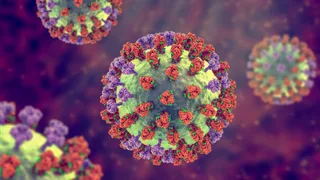
Google DeepMind's latest AI tool promises a new era for genetics research, but experts warn to take its predictions with caution
Google DeepMind has revealed a new artificial intelligence (AI) tool that can predict the molecular impacts of tweaking any one of the billions of letters that make up our genetic code.
On Sept.
8, Google's AI powerhouse announced a freely available database called AlphaGenome Atlas , which contains data on 9 billion possible changes to the human genetic code and estimates how these changes will affect different tissues and cellular processes.
What's more, the tool spits out a simple score to help scientists quickly weigh the knock-on impacts of these changes.
How a sequence of 3 billion or so letters of chemical code is packaged, delivered and read to create a human life is a major question in genetics research.
Last year, DeepMind announced a tool that could propel researchers toward an answer.
The tool, called AlphaGenome , predicts how changes to a DNA sequence alter proteins, cells and, ultimately, the human experience.
Now, one year later, DeepMind has released AlphaGenome Atlas, which the tech giant hopes will make AlphaGenome accessible to more researchers.
"It looks like a great resource," Greg Findlay , a group leader at the Francis Crick Institute in London who isn't involved with AlphaGenome Atlas, told Live Science.
However, other experts said that, although the tool is a step forward, it still can't answer all of the big questions in genetics .
"It's not this holy grail," Tuuli Lappalainen , a professor in genomics at KTH Royal Institute of Technology in Stockholm and a senior associate faculty member at the New York Genome Center who isn’t involved with AlphaGenome Atlas, told Live Science.
Reading the future of genetic variants Lappalainen's lab has been using AlphaGenome to study the effects of variation in genomes over the past year.
She pointed out that this technology is not new.
However, according to Google DeepMind, AlphaGenome outperforms previous models in the resolution at which it can predict the impact of changes to the genome.
5News aggregated this summary from the outlet’s public feed. The full article, with all the context, is on www.livescience.com — the content belongs to Live Science.