Interstellar comet 3I/ATLAS likely formed where its star's light couldn't touch it
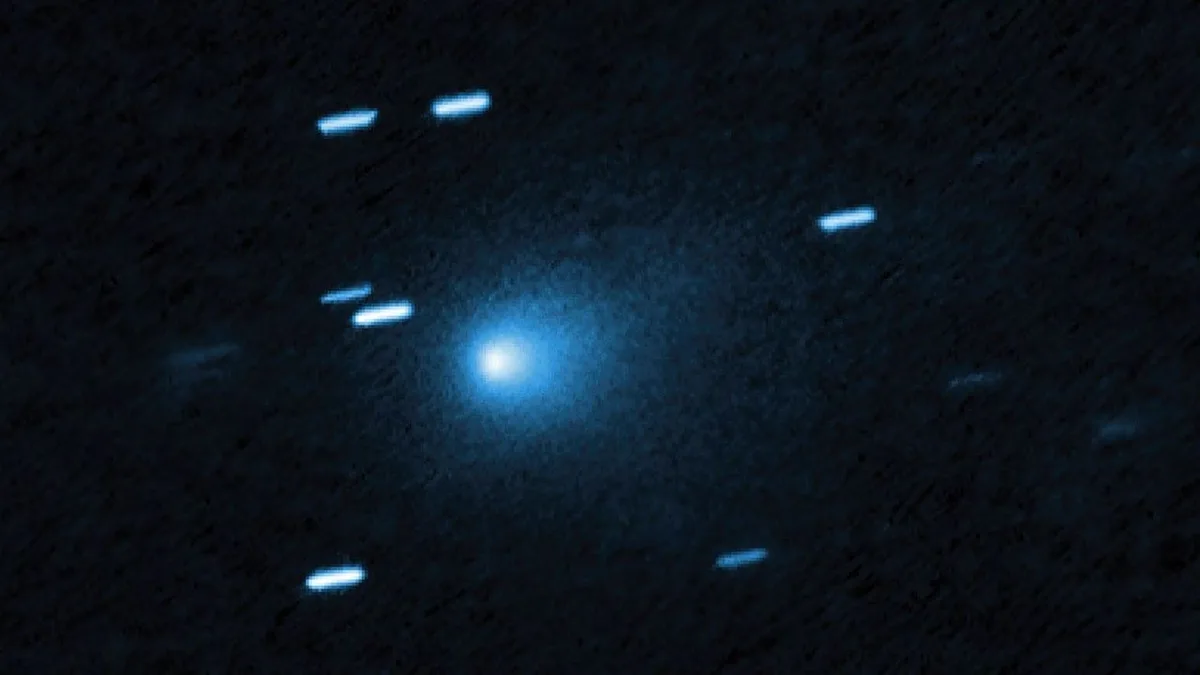
It has now been just over a year since the comet 3I/ATLAS first captured the world's attention as the third known object to fly through our solar system from beyond.
Astronomers are still learning new things about where exactly it came from.
For the first time ever, they've been able to study charged particles in the tail of the interstellar comet .
This has told them that 3I/ATLAS contains more nitrogen than the typical comet from our own solar system — revealing a tantalizing clue about how the strange comet formed.
"Finding that it's so rich in nitrogen tells us it likely formed in extremely cold conditions, far from its home star," Lea Ferellec, a research fellow at Northumbria University, said in a statement .
Ferellec's group used the William Herschel Telescope in Spain's Canary Islands.
One of this telescope's instruments is a fiber-optic weave named, well, WEAVE .
WEAVE lets astronomers do spectroscopy — which splits incoming light into its spectrum.
Different chemical elements absorb and emit different wavelengths of light, marking that spectrum with different characteristic fingerprints.
With spectroscopy, astronomers can look at a celestial object's light, pick out the fingerprints, and reconstruct the stuff inside.
Other astronomers have measured 3I/ATLAS with spectroscopy, but they've mostly examined the comet's coma , a shell of gas that forms when the sun’s heat sublimates the comet’s ice into vapor.
Of course, a coma is not the only feature that forms as a comet approaches the sun .
Close in, a comet is battered by the torrent of the sun's solar wind, which pushes the comet's material away into a distinctive tail.
In the process, the solar wind's high-energy particles strike the comet's molecules and electrify them into charged ions.
5News aggregated this summary from the outlet’s public feed. The full article, with all the context, is on www.space.com — the content belongs to Space.com.