How did Roman aqueducts get water to go uphill?
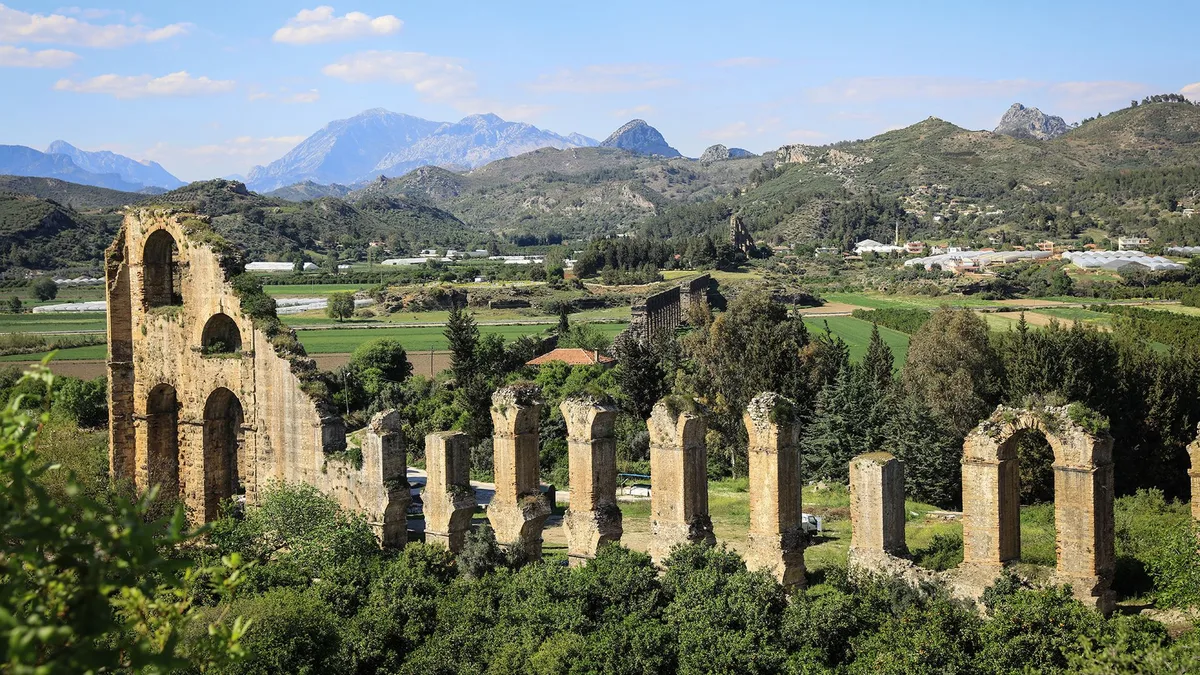
Aqueducts are some of the ancient Romans' most prominent surviving archaeological remains.
These aqueducts relied on gravity to bring down the water to cities gradually.
But some, such as the aqueduct at Aspendos in Turkey, had sections where they had to go uphill.
So how did the Romans get water to flow upward ? The Romans used a few methods, including siphons and various water-lifting devices, experts told Live Science.
Inverted siphons One strategy was a system called an inverted siphon (sometimes simply called a siphon).
At Aspendos, in southern Turkey, there is a second-century-A.D.
Roman aqueduct with inverted siphons that scholars have reconstructed with a virtual modeling simulation.
To get water through a valley, the Romans built a "header tank" on one end of the valley and a slightly lower "receiving tank" (or "outlet tank") on the other side.
In the valley, they constructed two towers between the tanks, Paul Kessener , a researcher in the Department of Language and Culture Studies at Radboud University in the Netherlands, noted in an article published in 2000 in the Journal of Roman Archaeology .
As water dropped down a steep hill, the resulting pressure pushed it up the first tower before dropping it steeply down the other side, with the force allowing it to climb the second tower.
The water eventually reached the receiving tank on the other side of the valley and continued toward the city of Aspendos.
It was important to prevent air pockets from forming as the water went through the inverted siphons.
The header and receiving tanks were relatively large, allowing air bubbles to escape, Giovanni De Feo , a professor of industrial engineering at the University of Salerno in Italy, noted in an email.
"As the flow entered a relatively large chamber, its velocity decreased, allowing air bubbles to rise naturally to the water surface and escape through the open top of the structure," De Feo explained.
5News aggregated this summary from the outlet’s public feed. The full article, with all the context, is on www.livescience.com — the content belongs to Live Science.