Scientists shrank mice's brains and replaced the missing tissue with human 'organoids'
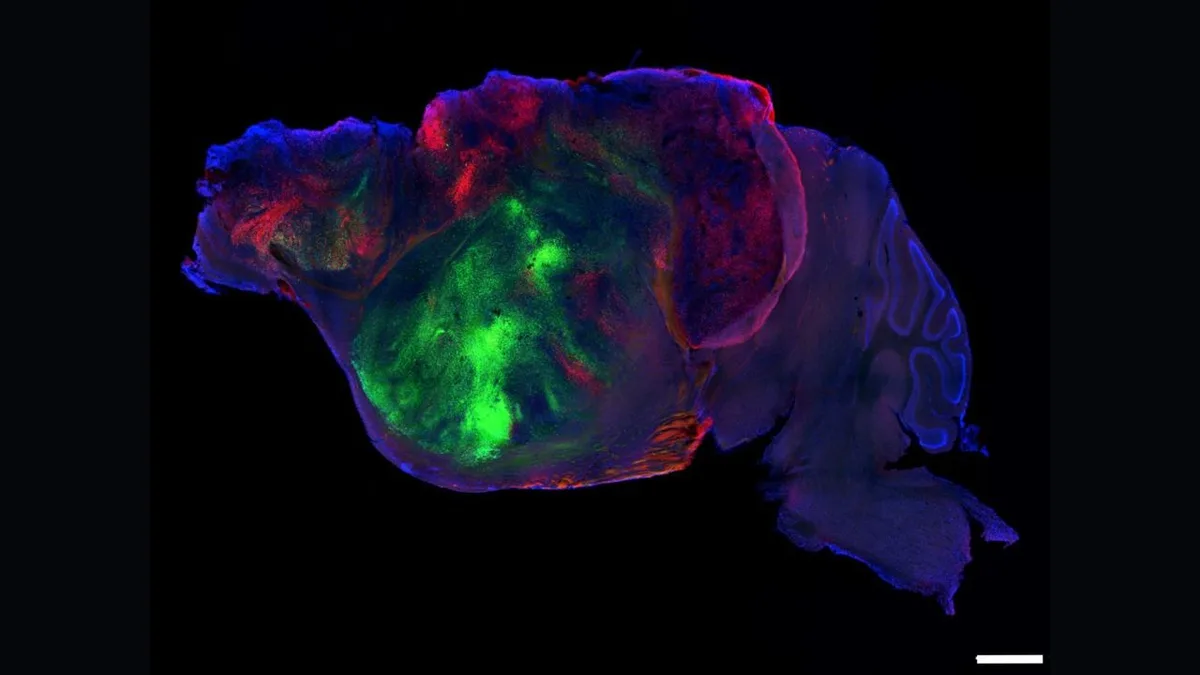
In a new study, scientists reared lab mice that were missing sections of their brains and then replaced the missing tissue with human cells.
The experiment represents a step forward in the study of human brain organoids — tiny models of the human brain grown from stem cells.
In the long run, scientists aim to use organoids to better understand how the brain develops and how its structure and function change in the context of disease.
"It is definitely an advance in the field," said Dr.
H.
Isaac Chen , an associate professor of neurosurgery at the University of Pennsylvania Perelman School of Medicine.
Chen was not involved in the current study but has conducted experiments transplanting human brain organoids into rodents' heads .
Organoids offer a window into early brain development that's impossible to observe closely in humans, namely because it unfolds inside developing fetuses.
Although organoids are not perfect re-creations of full-size human brains , scientists think organoids are useful models for studying the developing brain in both health and disease.
The model in the new study "certainly creates some pretty interesting options in terms of modeling human neurodevelopment and various types of neurodevelopmental disorders," Chen said.
"If you're looking for a model that really allows you to look at larger areas of human neural tissue from a cellular, molecular perspective, I think there's a lot that this model has to offer." S.
Pasca lab, Stanford University S.
Pasca lab, Stanford University S.
Pasca lab, Stanford University Making space for human cells Often, brain organoids are grown outside living organisms, either in lab dishes or devices that keep these "minibrains" suspended in a solution.
5News aggregated this summary from the outlet’s public feed. The full article, with all the context, is on www.livescience.com — the content belongs to Live Science.