Hundreds of whale calves have mysteriously died in Patagonia — and scientists are racing to find out why
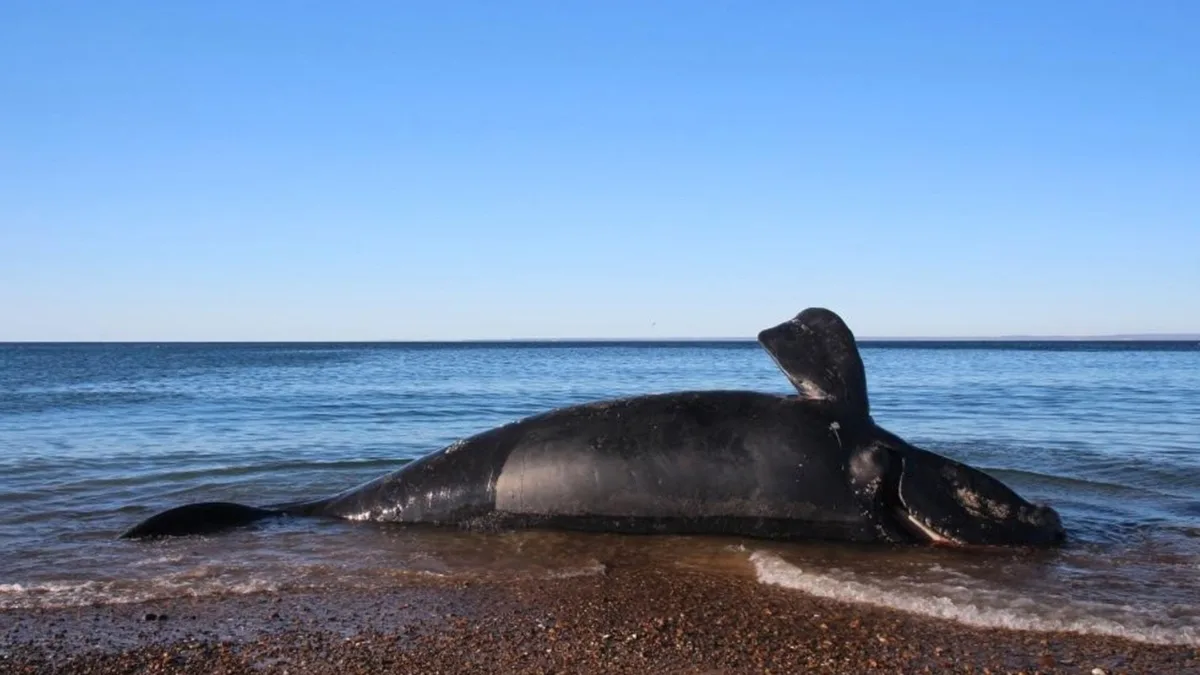
Since June, more than 300 southern right whale ( Eubalaena australis ) calves have died in Argentine Patagonia, in what scientists describe as an "exceptional" die-off.
The preliminary figure already far exceeds the previous annual record set in 2012, when 113 southern right whale calves died — the highest number ever documented for the species , both locally and globally.
Now, scientists are racing to figure out exactly what's causing the record-breaking die-off.
Laboratory analyses of specimens that died this year tested positive for the pathogenic bacterium Erysipelothrix rhusiopathiae , environmental authorities in Chubut province told Live Science.
E. rhusiopathiae was first identified in southern right whale calves in 2013 , but scientists don't know what might have changed this year to cause an infection-driven die-off of this magnitude.
Researchers say they need to quickly find the answer to better understand the changing threat this species faces, the risk to the wider ecosystem and humans, and what can be done to manage it.
"The battle between living organisms and pathogens is constant," said Carla Fiorito , a researcher at the Center for the Study of Marine Systems (CESIMAR) who previously identified the bacterium in right whales.
"But for this to happen now, there must have been a shift in the balance between the agent, the host, and the environment," she told Live Science.
Record-breaking number The first dead calves appeared on the beaches of Península Valdés in June, at the start of the breeding season, which runs through to December.
Península Valdés is located in Chubut province, on the coast of northern Patagonia.
In a typical year, calf mortality reaches 20% to 30% of a cohort from various causes, including infections.
But this year's losses have already far surpassed that.
In September, 409 calves were counted among a total of 1,375 southern right whales during a survey conducted by CESIMAR's Marine Mammal Laboratory .
With more than 300 deaths already recorded, the die-off represents an exceptional proportion of these calves.
5News aggregated this summary from the outlet’s public feed. The full article, with all the context, is on www.livescience.com — the content belongs to Live Science.