Haunting Hubble telescope image captures cosmic cycle of destruction and creation — Space photo of the week
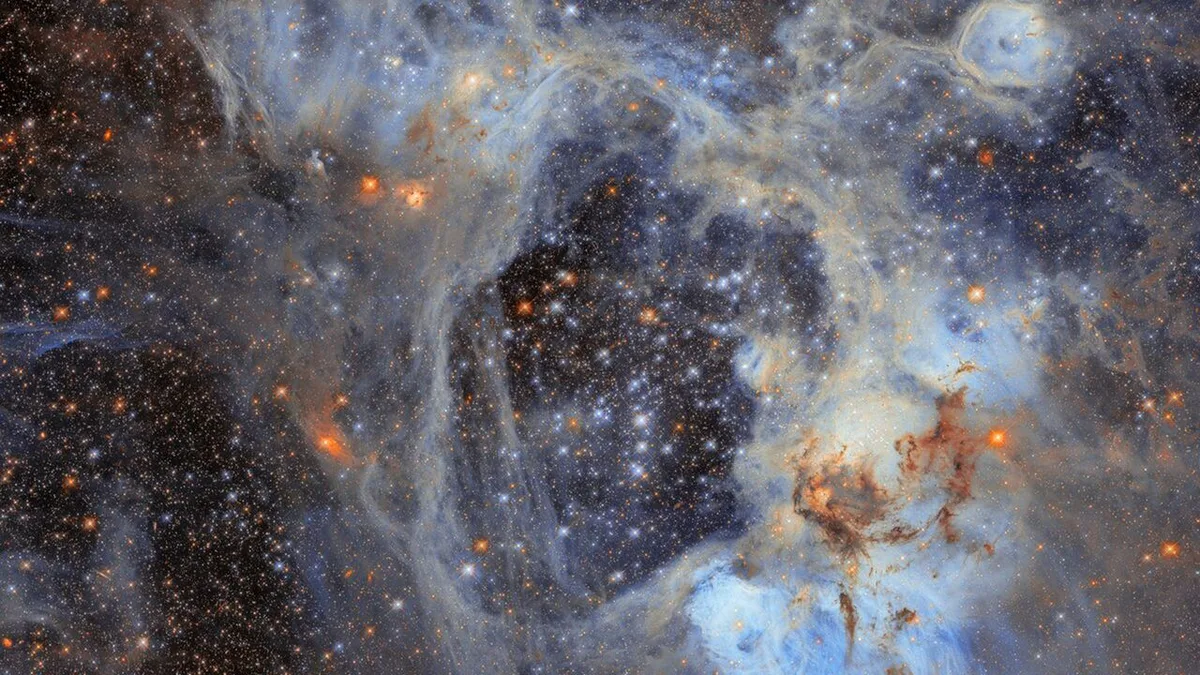
Quick facts What it is: The nebula LHA 120-N44 Where it is: 160,000 light-years away, in the constellation Dorado When it was shared: Sept.
3, 2026 It looks like a gigantic hole punched through a cloud, but this spectacular new image from the Hubble Space Telescope captures something more complicated: a cosmic cycle of destruction and creation, with one generation of stars tearing apart its birthplace while simultaneously helping a new generation form.
LHA 120-N44 (N44, for short) is a nebula that lies about 160,000 light-years away in the Large Magellanic Cloud, a small galaxy that orbits the Milky Way .
From Earth, it appears in the constellation Dorado.
This enormous, empty-looking region measures roughly 210 by 140 light-years.
To put that into context, consider that Alpha Centauri , the closest star system to ours, is a mere 4.4 light-years distant.
Thanks to that giant, hole-like appearance, this nebula is known as a superbubble, a cavity carved out by a cluster of hot, massive stars near its center.
Those stars are bent on destruction.
Just like our star's solar wind, which creates auroras on Earth and defines the extent of the solar system, these stars' powerful winds blast material into space.
Meanwhile, the most massive of these stars eventually explode as supernovas, pushing even more gas aside.
The collective radiation from both these old and young stars carves the nebula's giant cavity.
So what happened to that expelled gas? Most of it has been pushed outward and compressed into a dense shell of gas and dust surrounding the superbubble.
Within that shell, new stars are forming — so the same massive stars that destroy the gas cloud that created them also may help to produce their replacements.
This is known as "stellar feedback" — when massive stars heat, ionize and disperse the gas and dust around them, making star formation impossible in their vicinity.
5News aggregated this summary from the outlet’s public feed. The full article, with all the context, is on www.livescience.com — the content belongs to Live Science.