Scientists discover mysterious new X-ray objects 'unlike any they have seen before'
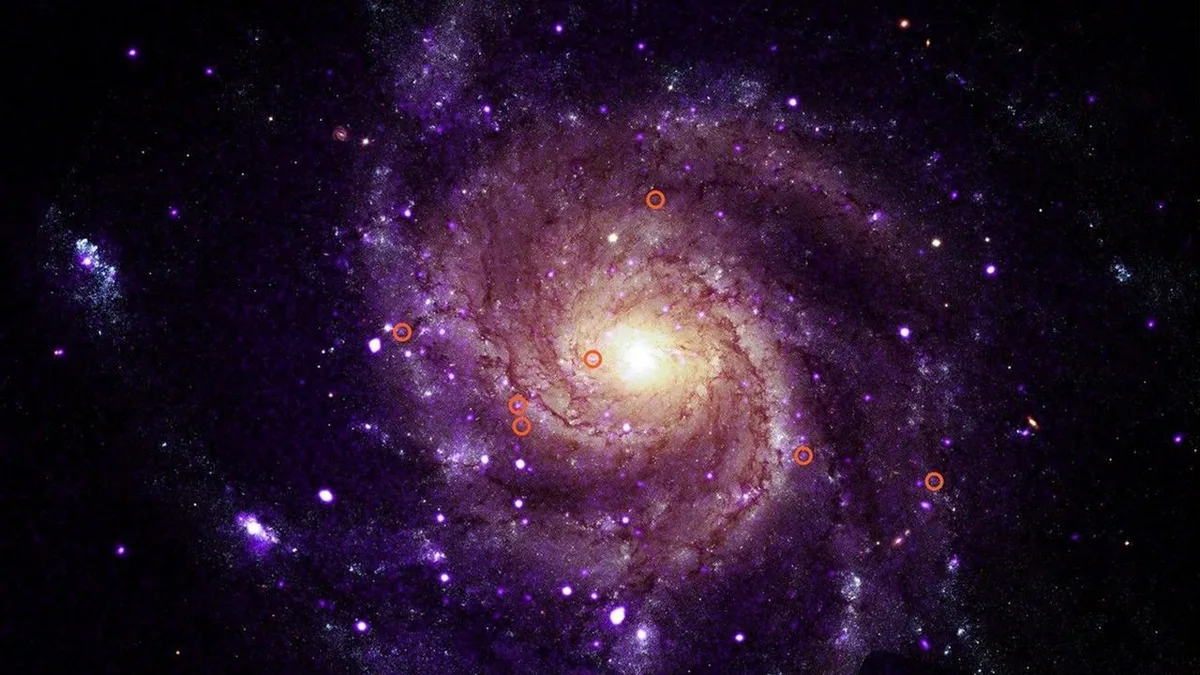
NASA's Chandra X-ray Observatory has found a brand new type of an otherwise familiar object – compact binary systems that steal gas from other stars, but which do so while emitting very low-energy X-rays but copious amounts of ultraviolet.
Chandra spotted 84 suspicious object emitting very low-energy X-rays in six galaxies – four evolved ellipticals and two spirals, namely our near-neighbor the Andromeda Galaxy (M31) and the Pinwheel Galaxy (M101).
"We've never encountered a group of objects that act like this," said Mustafa Muhibullah of the University of Alabama in a statement .
Compact objects, in the form of black holes , neutron stars and white dwarfs , are the remains of stars that have died.
Their small size and powerful gravity means that they're adept at getting close to orbiting companion stars and ripping the stars' outer layers of gas away.
The gas swirls around the compact object, falling onto its surface, and this accretionary process usually produces torrents of high-energy X-rays because the stolen gas becomes superheated by the compact object's gravitational vice-like grip.
Because of their weak X-rays, Muhibullah's team refer to them as 'hypersoft X-ray sources'.
Since low-energy X-rays and ultraviolet light are next to each other on the electromagnetic spectrum , Muhibullah and his team suspect that the low-energy X-rays are spillover from objects emitting prodigious amounts of ultraviolet.
Moreover, they think that these objects are lower-level compact binaries.
They're hard to find though, because the interstellar medium of hydrogen and helium gas between the stars absorbs ultraviolet light.
This could be why we have yet to find any hypersoft X-ray sources in our own galaxy, because we have to look through the interstellar medium through the plane of the Milky Way .
Consequently, there could be a large population of hypersoft X-ray sources that remain undiscovered and they could have an important effect on the universe around them.
"These clandestine X-ray sources are actually among the most energetic objects in galaxies, and they could be solving two cosmic mysteries at once," said Muhibullah.
The interstellar medium is filled with ionized gas where atoms have been shorn of electrons .
5News aggregated this summary from the outlet’s public feed. The full article, with all the context, is on www.space.com — the content belongs to Space.com.