Rocket Lab launches private Japanese Earth-observing satellite to orbit (video)
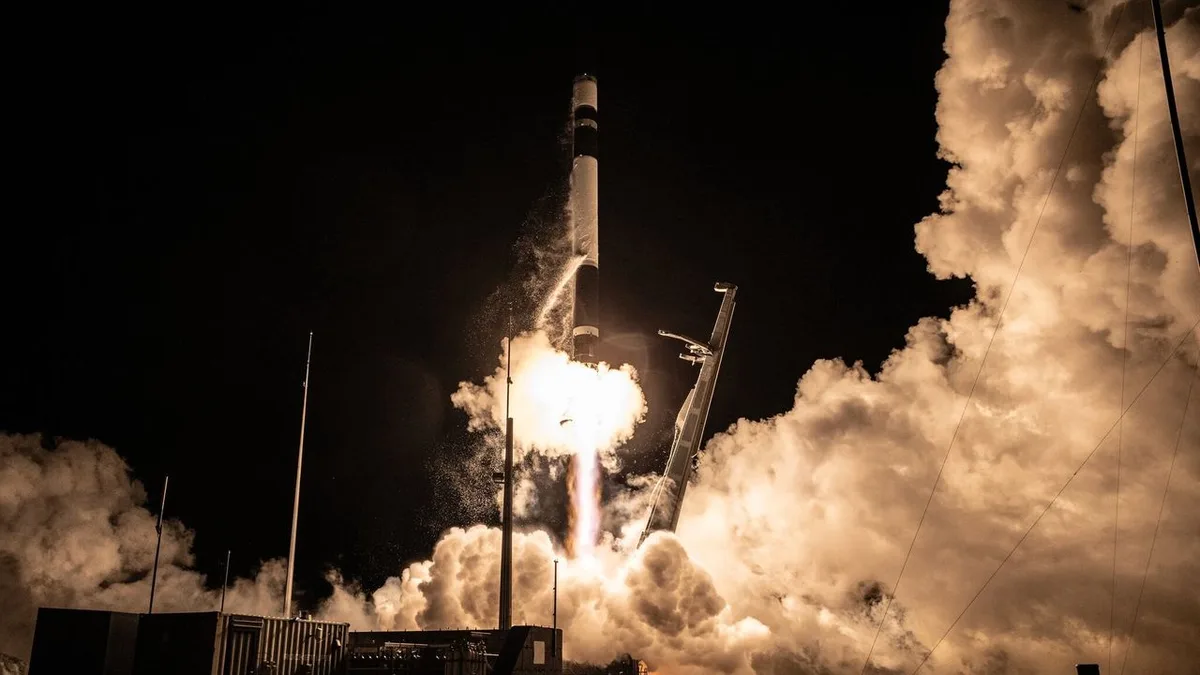
Rocket Lab launched a private Japanese satellite to orbit this morning (Aug.
20), adding to a growing constellation of Earth-observing spacecraft.
An Electron vehicle lifted off from Rocket Lab's New Zealand site at 9:04 a.m.
EDT (1304 GMT; 1:04 a.m. on Aug.
21 local New Zealand time), carrying aloft a radar satellite for the Tokyo-based company iQPS.
The nine 3D-printed Rutherford engines that power Electron's first stage shut off as planned about 2.5 minutes after liftoff.
Separation with the rocket's second stage immediately followed, which burned for another 6.5 minutes before releasing Electron's "kick stage" with the IQPS payload for a 40-minute coast phase.
Electron lifts off from Rocket Lab's New Zealand launch site at 9:04 a.m.
EDT (1304 GMT) on Aug.
20. (Image credit: Rocket Lab) This was Rocket Lab's ninth launch for iQPS, which is building a constellation of 36 synthetic aperture radar (SAR) satellites in low Earth orbit (LEO).
Such spacecraft can study Earth day or night, and they can peer through cloud cover as well.
The iQPS network "is being developed and deployed at a rapid pace to provide high resolution and near-real time SAR imagery to its global users," Rocket Lab wrote in a description of today's mission , which it calls "The Lightning God Defends." That name is a reference to the satellite going up today: It's nicknamed SUSANOO-II, after a Japanese lightning god.
Following the 40-minute coast phase of Electron's kick stage, the rocket completed one final burn to circularize its orbit and successfully deployed SUSANOO-II about 50 minutes after launch, at an altitude of 357 miles (575 kilometers).
Today's flight was Rocket Lab's 14th of 2026 and 93rd overall.
5News aggregated this summary from the outlet’s public feed. The full article, with all the context, is on www.space.com — the content belongs to Space.com.