James Webb Space Telescope finds 'hidden stars' making the universe's 1st galaxies much bigger than we knew
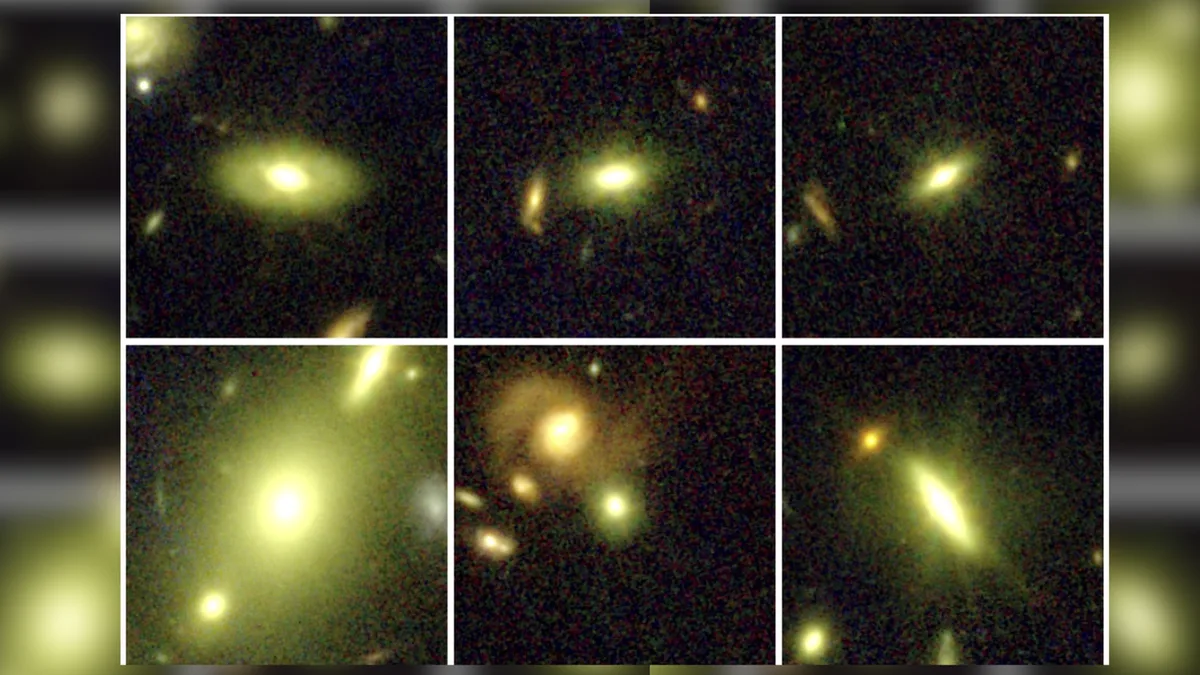
Imagine looking at a vast city on Earth from a great distance, knowing nothing about that city; you may assume that its only buildings are the largest, most visible skyscrapers.
But, get closer or look with a far more powerful tool, and you would begin to discover smaller buildings between mountainous skyscrapers.
Now, the James Webb Space Telescope has discovered that this looks like that is a fitting analogy for early galaxies.
Astronomers are finding that in between the brightest stars, the 'tallest skyscrapers' in the above analogy, there are much fainter stars analogous to smaller buildings.
That means early galaxies may actually have a lot more mass packed into them than we believed.
The team behind this research reached this conclusion by using the James Webb Space Telescope (JWST) to study nine early galaxies that have passed through their period of intense star formation.
They combined this data with observations from the Very Large Telescope (VLT) here on Earth to measure the population of small and faint stars in these galaxies for the first time.
What they found was that the proportion of small stars in these galaxies is much greater than is found in modern galaxies like the Milky Way .
This comes as something of a surprise to scientists who have assumed these populations would be similar.
"This means that the galaxy as a whole is much more massive than previous estimates suggested," team member Chloe Cheng of Leiden University, Netherlands, said in a statement .
The first 'cosmic cities' weren't dominated by skyscrapers, it just looks that way Astronomers study galaxies and calculate their stellar population rates using the total light, or spectrum , coming from these cosmic metropolises.
The problem is, the more massive a star is, the brighter it is.
Thus, the overall spectrum of a galaxy is dominated by the most massive stars, while smaller stars are drowned out.
The sensitivity of the JWST has allowed astronomers to finally give these smaller stars a chance to shine and stand out, like spotting an incredible piece of architecture in a vast metropolis of glass and steel.
5News aggregated this summary from the outlet’s public feed. The full article, with all the context, is on www.space.com — the content belongs to Space.com.