The Silent War on South Africa's Women
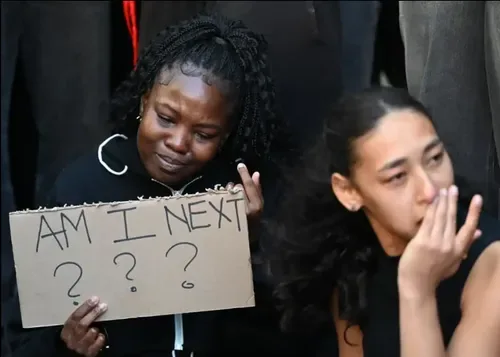
A protester holding a placard that reads "Am I next?" weeps beside a fellow demonstrator during a silent protest against violence against women in Cape Town on Wednesday.
To look at South Africa today is to witness a society where being born female carries a terrifying tax. The numbers are not merely sobering; they are a direct indictment of a broken state. According to official data from the South African Police Service (SAPS), 5,578 women were reported murdered in the full financial year covering April 2023 to March 2024 alone. That scales out to a horrific reality of 15 women slaughtered every single day. Even when looking at quarterly data, between April and June alone, 569 women were murdered, while another 1,052 survived attempted murders.
The state's overall female homicide rate hovers around 24.6 per 100,000 people, which is roughly six times the global average. When it comes to intimate partner femicide, the rate stands at 5.5 per 100,000 women, which is five times higher than the global baseline. These are not passive data points. They represent daughters, mothers, and sisters whose lives were brutally extinguished, often by the very men who claimed to love them.
A deep interrogation of this crisis reveals that femicide is not a series of isolated criminal acts. It is the predictable outcome of a profoundly compromised institutional architecture. The South African state has repeatedly demonstrated a staggering inability, or unwillingness to protect its female citizens. The justice system functions less like a shield and more like a bureaucratic labyrinth designed to wear down survivors and protect perpetrators.
The state’s failure begins at the police station. Facing deep detective shortages and an infamous, perennial backlog in forensic DNA laboratories, the police service regularly botches investigations before they can even reach a courtroom. Protection orders, touted by politicians as legal lifelines, are functionally toothless. In a cruel twist of systemic neglect, the process often requires the victim to track down and serve the abusive partner themselves, transforming a legal safeguard into a catalyst for fatal retaliation.
When cases do progress, the National Prosecuting Authority (NPA) frequently stumbles, sabotaged by poor file management and under-resourced courts. The reality is that men kill women in South Africa because they know they can get away with it. Impunity has become normalised, woven into the very fabric of the legal infrastructure.
The government's response has historically been a performative exercise in policy generation. We have seen the National Strategic Plan on Gender-Based Violence and Femicide passed with great political fanfare. We have heard presidential addresses decrying the crisis. Yet, these initiatives remain severely underfunded and completely detached from the daily realities on the ground.
Writing laws is cheap; enforcing them requires political courage and resource allocation that the administration continually fails to deliver.
5News aggregated this summary from the outlet’s public feed. The full article, with all the context, is on iol.co.za — the content belongs to IOL.